
Orange Is the New Black
Stablecoins, conspiracy theories, and the plan for continued American financial and geopolitical dominance.

“Bitcoin is the new oil.” – Donald Trump (reportedly)
I love a good conspiracy theory. That can get you labeled as a kook or a lunatic. Maybe less so than in decades past, as so many conspiracy theories these days seem to have one or even a few kernels of truth in them.
But I embrace it all – the rolled eyes and the ridicule. Maybe I am a kook, or at least gullible – prone to tying threads together that may or may not belong tied. And they often lead me to making conclusions about a given topic for which the absolute truth is debatable and unknown. No, the earth is not flat. Don’t be a retard. If it were, people at the top and bottom of the Burj Khalifa would be able to stop their Ramadan fasts at the same time. And yes, Elvis did actually die 48 years ago last week.

But yeah, I think the CIA and LBJ had a hand in murdering JFK. And I think all those early Covid videos that showed casino workers and restaurant staff in Macau and mainland China keeling over from a mysterious ailment were probably faked or at least taken out of context and marketed globally to scare you into accepting months and even years of draconian lock-down policies. Maybe I’m right, maybe I’m wrong on these. But since Covid, I am much more inclined to think along the lines of this ironically-asked question.
Q: What’s the difference between a conspiracy theory and a fact?
A: About six months.1
So am I a conspiracy theorist? No. But I think you’d have to be gullible to not believe that there are some nefarious rich and powerful people in this world, and that sometimes they get together to conspire against others on various topics. Many years ago, I read a book titled Them: Adventures with Extremists. It was written by British author Jon Ronson, and it was a thoroughly enjoyable read. It delved into stories about the KKK, Jihadists, and the very human and PR disaster that was the Ruby Ridge standoff. As you can imagine, there were comedic and tragic elements throughout the book. The one chapter that stood out to me, though – the one chapter that, when I read it, even my younger, less cynical self thought, yeah, that’s probably all true – was the chapter on the Bilderberg Group.
Now, I’m not saying that the Bilderberg Group is some sort of annual gathering of a “Satanic shadowy elite group” of pedophiles. I’m totally not saying that at all – totally.2 But I am saying that since its formation in 1954, it wouldn’t surprise me if a whole lot of conspiring went on in these annual meetings in order to “nudge” global economic and political systems in certain directions beneficial to the individual attendees and their friends.3 And as the global economic system of today (if you scratch just a millimeter or so beneath the surface) is showing signs of weakness and fragility in ways that we have seen before, it makes sense to try and study whatever we can find about how the “global elite” tried to handle similar problems in past decades.
The United States has an inflation problem. With this recent July CPI print, that made up number has been above the Federal Reserve’s made up 2% target for over fifty straight months now.
The United States has a spending problem. That DOGE experiment lasted about two months before being completely abandoned, and the demographic make up of the country is such that no politician who values his or her job, and the gravy train of riches that await if they play their cards right, would ever vote to cut anything that would actually make a dent in the budget deficit.
And yet, America still needs to sell its debt to keep it all rolling along…
The purchasers of US treasuries fund America’s lifestyle. Buyers exchange the product of their time and energy – their proof of work in this world – for dollars, and lend them to the US government on the promise of a return in the form of a coupon payment on that loan.
But if the purchasing power of the dollars that America promises to pay these investors keeps eroding, then wouldn’t the buyers of those dollars eventually either a) invest the product of their time and energy (their proof of work) in some other asset, or b) withhold the product of their time and energy in order to demand a better real rate of return on their proof-of-work-generated funds?
Yes, of course they would. And with America’s hyper-financialized economy that has progressively stopped actually making things over the past forty years, but has been exponentially adding debt to fund a certain lifestyle, the unspoken goal of inflating debt away via currency debasement has led to a life of stagflation for the non-moneyed Great Unwashed4 — i.e. the middle and lower classes.
It is my contention that we have seen this all before – most recently in the 1970s. If that is true, then we can know what the game plan will be to remediate the issues at hand. And even though we do not have an energy crisis and gasoline shortages as we did in the 1970s, the dynamics of what happened with the Arab oil embargo is, I believe, a lot more relevant to today’s situation than most people think. And I believe that the Trump administration thinks so too.
“Who needs a car and a 747 when you can’t buy a gallon of gas?” — Ray Davies
If you are younger than 60 years old, you can be forgiven for not knowing who Sheikh Ahmed Zaki Yamani is. He was a Saudi Arabian politician who served as the Minister of Petroleum and Mineral Resources for the country from 1962 to 1986. 5
And if you know a bit of history, you’ll know that this time-span included the Arab oil embargo. Ahmed Zaki Yamani died in 2021 at the age of 90, and in his obituary,6 The Guardian newspaper wrote (highlights added in this and all subsequent quotes):
“In the 1970s and 80s Ahmed Zaki Yamani, who has died in London aged 90, was a symbol of the new age of oil, wealth and power that “black gold” accorded to his homeland Saudi Arabia...
Yamani served as petroleum and mineral resource minister under four Saudi monarchs... He was also a highly influential figure in the Organisation of Petroleum Exporting Countries (Opec), founded in 1960. For most of that decade oil was less than $2 per barrel.
Yamani first captured world attention during the crisis that erupted in October 1973 when Egypt and Syria launched their war on Israel, following its victory in 1967. King Faisal, initially reluctant, in solidarity with other Arab oil exporters and Iran, initiated production cuts and halted supplies to the US and other western countries. The Arab embargo was the response to Washington’s unwavering support for the Jewish state.
Oil prices then quadrupled globally, triggering an international crisis and generating vast wealth for producers. “We are masters of our own commodity,” Yamani declared. Until 1973 the Saudis had earned $8-9bn a year. By spring 1974 their annual revenues were $34bn, though Faisal’s role in the embargo had ended by then. Rising consumption contributed to increased profits. The jokey pun ‘Yamani or your life’ reflected his global fame.”
If you watch old interviews with Yamani, you see a man who did not go out of his way to gloat about his nation’s or his own personal position of power, but he seems to be a man who knew very well that he had the Western world by the balls.
But did he?
He was a talented man for sure, but living on top of all that “black gold” in the 20th century really is the epitome of the phrase “at the right place at the right time” – not just due to the globally necessary commodity beneath his feet, but from the need for a post-gold standard United States Treasury Department to find a new buyer of their debt.
And so here’s a “conspiracy theory” that I totally believe. The Arab oil embargo was planned and purposefully carried out at the behest of the United States “Deep State” as a post-gold standard way of inflating the demand for US treasuries.
Analysts like Luke Gromen have commented on this topic over the past few months, and if you dig out the primary sources, you can find that Yamani said so himself. A 2001 interview with journalist Oliver Morgan states it explicitly and you can still find it online.
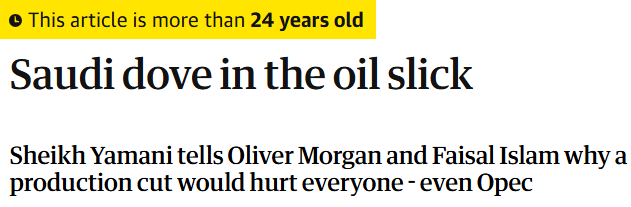
In the article it states:
“At this point he makes an extraordinary claim: 'I am 100 per cent sure that the Americans were behind the increase in the price of oil. The oil companies were in real trouble at that time, they had borrowed a lot of money and they needed a high oil price to save them.'
He says he was convinced of this by the attitude of the Shah of Iran, who in one crucial day in 1974 moved from the Saudi view, that a hike would be dangerous to Opec because it would alienate the US, to advocating higher prices.
'King Faisal sent me to the Shah of Iran, who said: "Why are you against the increase in the price of oil? That is what they want? Ask Henry Kissinger - he is the one who wants a higher price.’"
Yamani contends that proof of his long-held belief has recently emerged in the minutes of a secret meeting on a Swedish island, where UK and US officials determined to orchestrate a 400 per cent increase in the oil price.”
The article never mentions it by name, but the “secret meeting” was at the Grand Hotel Saltsjöbaden on the Swedish island of Saltsjöbaden where the 22nd Bilderberg Group meeting was held from May 11-13th in 1973, less than six months before the Arab oil embargo kicked off.
Now, as any good conspiracy theorist knows, the minutes of this Bilderberg Group meeting could have been edited, or faked, or it all could just be some sort of limited hangout7 to throw people like you and me off the trail of what was really discussed at that meeting.
But if the minutes can be believed, you can see how the worries discussed by the attendees are setting up the events that happened with the oil embargo not six months later – and Sheikh Yamani’s claims that it was orchestrated by the United States starts to make complete sense, the reasons for which I’ll get to shortly. The minutes, which you can find here and here are fascinating:
“1. The continued requests for price increases from Middle East producing countries, accelerated by the devaluation of the dollar. The international oil companies might wage a rear-guard action, but in the end they would yield rather than risk interruption of supplies. They believed it was up to the economies of the consuming countries to absorb these price increases.” [pg. 35]
And more:
“The potential impact of oil developments on the world monetary system was dramatically indicated by an American participant, who said that before the end of the century some 350 billion barrels of oil would be produced in the relatively small geographical area at the headwaters of the Persian Gulf. This production would be worth from one to more than three trillion dollars, according to the price per barrel.” [pg. 64]
And still more:
“As big as the monetary impact of the oil situation might become in the future, it would be ‘only a little addition – not much more than a tenth – to the deep mess which we are in already’, according to a German speaker. ‘We have first to solve the basic mess and then see to the oil problem, and not in the other order’… Unless confidence in the dollar returned, world monetary reform would be just ‘an abstract academic exercise’. America’s friends would help her, but first she had to set her strategy. Eventually we should work toward an international federal reserve system which could impose rules on foreign currency accounts. If the Euro-markets had been subject to regulation in the way that national banking systems were, things would not have gotten out of hand as they had done. It was important to recognise that the oil money question was merely a part of this much larger framework.” [pg. 65 and 66]
“Now, I’m calling all citizens from all over the world, this is Captain America calling. I bailed you out when you were down on your knees, so will you catch me now, I’m falling.” – Ray Davies (again)
So what does this all mean? It means, that if Sheikh Ahmed Zaki Yamani was right in the assertion he made publicly in 2001, the Arab oil embargo was not the result of greedy oil-producing nations squeezing Western consumers. It was not instigated as a form of political protest against Israel and America’s support for that country. These were elements and excuses used to explain the eventual 400% rise in oil prices. But the cause of it all, according to Yamani, whom I am inclined to believe, was the fact that America’s “Deep State” conspired to inflate oil prices because there was a dire need to prop up the US treasury market. Domestic and global investors alike had realized ever since President Nixon took America off the gold standard that the fully-fiat currency they were receiving as coupons on US treasury debt was not worth what it once was – and it was only getting worse.
The “secret deal” between America and Saudi Arabia is detailed in this article.
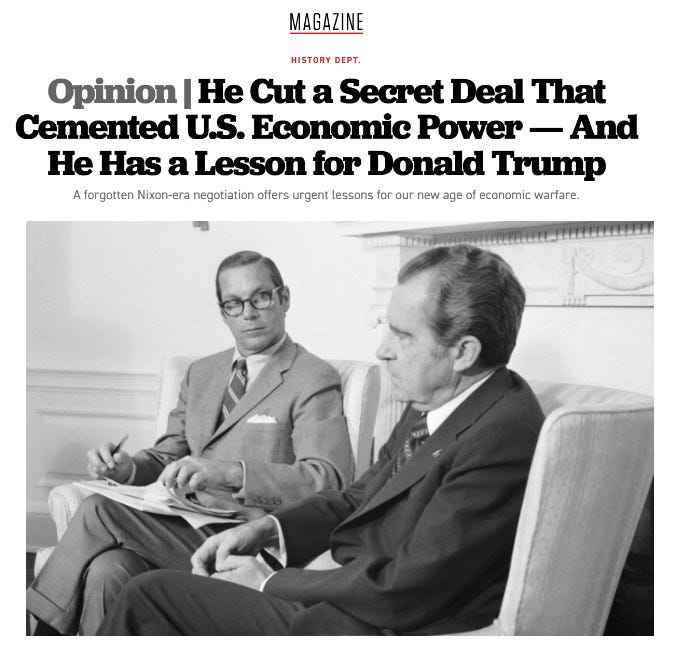
“The year 1973 was rough for the United States. The economy was in the dumps. Nixon’s decision to end dollar-gold convertibility two years prior had ushered in a system of floating exchange rates and caused the dollar to plunge. Years of heavy spending on the Vietnam War had degraded America’s financial health. Inflation soared to heights last seen in the 1940s. Instead of focusing on confronting these headwinds, Nixon floundered to contain the Watergate scandal.
To make matters worse, America was rapidly declining as an energy superpower and losing its traditional status as the swing producer in the global oil market. U.S. oil production peaked in 1970 and would not reach the same level again for 50 years. For the first time, the country became dependent on oil imports, largely from the Middle East.”
Richard Nixon sent his “pugnacious treasury secretary, William Simon, to Saudi Arabia to staunch the bleeding from a devastating oil embargo against the United States,” as the article states, espousing the standard “Party line” explanation of the events that unfolded.
The solution that came out of this trip was the foundation of the oil market that we still know today. Oil prices would never return to their pre-embargo levels, and the United States “convinced” Saudi Arabia to invest its windfall oil profits into US government debt.
“This way, the Saudis would essentially recycle the dollars America paid them for oil, plugging the U.S. deficit.”
It gets even better:
“In exchange for American military assistance and continued oil purchases, the Saudis would funnel their oil money into U.S. Treasury bonds, which they would be permitted to buy in secret outside the normal auctions. Simon had secured a commitment by a foreign country to finance American deficits – and the petrodollar was born.”
Again, think about what all this means. President Richard Nixon, Henry Kissinger, William Simon, and who knows how many other faceless Deep State goons (allegedly of course) colluded and conspired to massively inflate oil prices. This led to massive increases in oil revenues for oil-producing countries. These countries where then able to invest this newly acquired wealth in US treasury bonds. But there was a problem – the purchasing power of the dollar continued to plunge throughout the 1970s, and “the real value of Saudi oil profits fell in lockstep.”
So it took one more deal in 1975 to keep the Saudis on board and for them to influence OPEC to keep pricing oil in US dollars. Today, fifty years later, “Oil is still priced in dollars, and foreigners still finance American deficits. Petrodollars became a key ingredient in an increasingly global financial system – a system dominated by the United States.”
And this brings us to today.
Bitcoin solves this – seriously
So what the hell does the Arab oil embargo of the 1970s and the establishment of the petrodollar system have to with the situation we find ourselves in today? Everything, I would contend. Analysts like Luke Gromen have been on multiple podcasts over the past year or so drawing parallels between the petrodollar recycling system and Donald Trump’s vocal support of stablecoin regulation, institutionalization, and growth. You can see a good discussion of that here:
Discussing the conversation he had with other podcasters, Gromen recounts (edited for clarity):
“The son of a famous person said, ‘Yeah, my dad owns bitcoin now. Trump called him up and said bitcoin’s the new oil.’ And Preston [Pysh] and I were kind of like, ‘Whoa, that’s interesting.’ So the point was that, hey, he’s not just here, you now, basically pandering for votes...that there was actually a real strategic understanding and view from Trump himself that I don’t think a lot of investors appreciated at that point. And to be honest, I thought it was interesting. I didn’t really see the exact connection beyond sort of recognition perhaps by Trump of the proof of work energy tie, you know, to bitcoin, right? That basically is...I’ve said it over and over, bitcoin’s an energy linked neutral reserve asset, so that was kind of my takeaway”
Gromen continues, and this is where it gets really interesting.
“And then about three, four weeks ago the Treasury Borrowing Advisory Committee, they do a quarterly report. It’s very, very good. I think everyone should read it. The Treasury Borrowing Advisory Committee, TBAC, made up of senior execs of the biggest Too-Big-To-Fail banks and Wall Street firms. And they just sort of put together a report about fiscal debt, borrowing, etc., positions for the Treasury. And three weeks ago in the quarterly update they issued two different supplements, which is a little unusual...Supplement 1 was basically, ‘Holy cow, the US fiscal situation is screwed.’ Screwed’s too [strong a term]. ‘It is highly unsustainable and it is acute, and we need to do something’…
So the point is that serious people understand there’s a problem and there’s a problem now. Supplement 2 was ‘Digital Assets and the Treasury Market.’ So here you have the biggest banks telling the Treasury how digital asset markets could help finance this acute US fiscal and debt problem. Huh. So that made me think back and I almost forgot someone put the ‘bitcoin is the new oil’ in front of me right around that time and the penny dropped for me. And then I found, someone pointed out to me, ‘Hey, Paul Ryan wrote an op-ed.’ A former Vice Presidential candidate, former Speaker of the House. ‘Stablecoins could help the US with its debt problem’ in the Wall Street Journal, laying out some of the dynamic...So when I started putting these three together...it changed the way I was thinking about this ‘bitcoin is the new oil’ comment from Trump.”
Gromen then recounts the story I detailed at the beginning this article of Sheikh Yamani, the Bilderberg Group, and Henry Kissinger inflating the oil market. He continues:
“The point of the US doing that was essentially to make the oil market big enough to back US deficits to basically recycle the flows back into US debt, to basically fix the US fiscal problem post-Vietnam War and after we left the gold standard. It basically put us on an oil standard of sorts. And when I thought back to that interview by Sheikh Yamani, in light of the Treasury report, which was really the catalyst for the rethink, and then the Paul Ryan point, and then Trump’s, you know, in August [2024] where he said, ‘Hey, maybe we’ll just, you know, pay off our debt with a little bitcoin,’ which is a really odd comment. I started to wonder if, ‘Bitcoin is the new oil,’ that it is, bitcoin is going to be inflated like oil was so that it will inflate stablecoins, so that stablecoins will buy a lot more treasuries. Basically, bitcoin going much, much higher, this Treasury report showed that stablecoin demand for T-bills would soar.”
This interview was released December 3, 2024. Everything that has happened since then – the passing of the GENIUS Act, Trump and Treasury Secretary Scott Bessent trying to browbeat Jerome Powell into cutting rates, Trump signing an Executive Order to open the $9 trillion US retirement account market to bitcoin investments in 401K plans, it all smacks of what Gromen is talking about. But it goes deeper than even that.
“The Fed & Treasury Are Getting Remarried”
This was the title of a recent episode of The Jack Mallers Show Podcast.
Jack Mallers is someone who it’s worth your time to listen to. His podcast, more than most I think, brings the listeners’ attention to the interplay between bitcoin, the macroeconomic environment, and when government officials start “saying the quiet part out loud” on various topics. With Jack, there’s a ton of signal amid what to the untrained ear of a suit-wearer, probably seems like noise.
In that recent episode he goes in-depth on the recently-passed stablecoin bill, the GENIUS Act.
He plays a video of Treasury Secretary Scott Bessent saying (part) of the quiet part out loud:
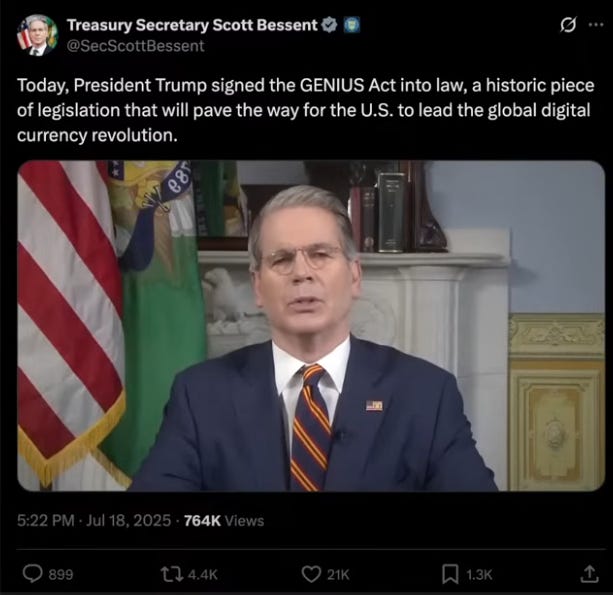
“Today marks a seminal moment for digital assets and global dollar dominance...Stablecoins represent a revolution in digital finance. The dollar now has an internet-native payment rail that is fast, frictionless, and free of middlemen. This groundbreaking technology will buttress the dollar’s status as the global reserve currency, expand access to the dollar economy for billions across the globe, and lead to a surge in demand for US treasuries which back stablecoins. The GENIUS Act is a Win-Win-Win for everyone involved, stablecoin users, stablecoin issuers, and the US Treasury department...By expanding financial freedom, and reinforcing dollar dominance, stablecoins will play a critical role in Making America Great Again.”
Pretty incredible if you ask me. But that was just half the quiet part. The other half is where the light bulb moment really happens. Here’s where the speculator, critical thinker, and conspiracy theorist in me totally signs on to the dots being connected by the likes of Jack Mallers, Luke Gromen, and a handful of others on the fringes of the serious and respectable financial world. Mallers showed a chart. It shows bitcoin’s market cap along with the market cap of USD Tether (USDT) – by far the largest stablecoin.
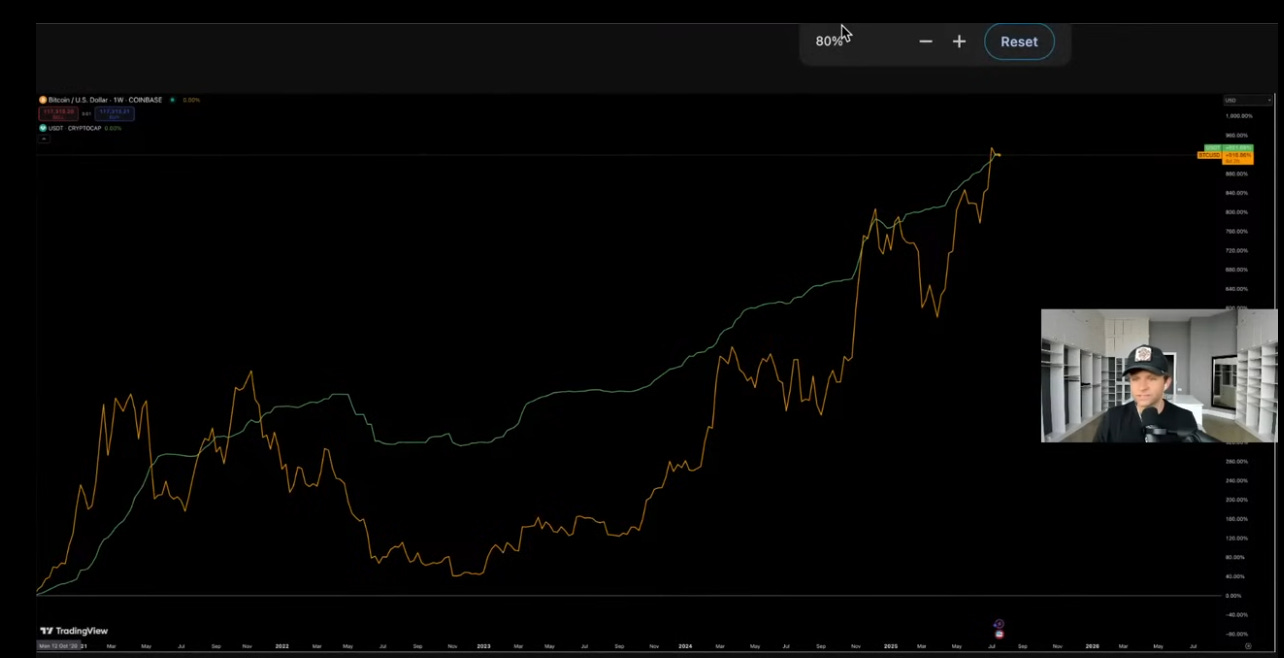
Mallers comments:
“Yes, stablecoins are a way to export the dollar to those who don’t have access to it. But they’re also the reserve trading pair against bitcoin as the global liquid commodity.”
What does it mean to say that bitcoin’s most liquid trading pair is BTC/USDT?
Remember, Americans don’t need Tether.8 But BTC/USDT is the default trading pair for BTC in every market outside the United States. Mallers notes in a subsequent podcast episode that if BTC’s price goes up and there’s more liquidity – i.e. if a $2 trillion BTC market cap doubles to a $4 trillion market cap, then trading volume will also basically, mathematically, double, and that means you need more USDT to support this expanded BTC market.
USDT is minted along with along with BTC’s price. Mallers notes that the BTC market cap has historically been between 2 ½x – 10x USDT’s market cap.
So here’s the rest of the “quiet part.” If Scott Bessent says he thinks stablecoins will get to $2 ½ to $3 trillion in size (oh baby, just think of how many short-term treasuries they would buy then!), that means, to do that, bitcoin could easily be expanded to a $6.25 trillion to $30 trillion market cap. That would imply about $300k to $1.2 million per coin. And we are talking about within this Trump administration.
The quickest, easiest, and best way (why it’s “best” I will get into momentarily) to grow demand for stablecoins, and therefore short-term US treasuries, is to send bitcoin higher – a lot higher. Tether is the reserve trading pair against much of the shitcoin space as well, so the administration seems to be ok with inflating that also to help grow stablecoins even more. But this is much less consequential. Bitcoin is how they will get this done.
I quote Jack Mallers again:
“Bitcoin is rare. And it’s accessible to everyone. It knows no borders. It has no nation-state. It has no central bank. Its unique default trading pair, the currency pair that does the most volume against this asset class is USDT – is Tether. OK? So, they grow together. They are very correlated. When bitcoin grows, Tether has to grow. I’ll say it one more time. When bitcoin grows, Tether has to grow. There is a direct relationship where, if bitcoin’s going to be $20 trillion, then take whatever the ratio is today and multiply it by 10 for Tether.
Stablecoin market cap has always ranged between 2 ½ to 10. Bitcoin has been 2 ½x the size to 10x the size of the stablecoin market cap, ok? So when Scott Bessent says, ‘I think stablecoins can grow to $3.7 trillion,’ if we take the upper bound of that range for bitcoin, he’s therefore saying, without explicitly saying it, ‘I think bitcoin can go to $37 trillion in market cap.’ Which by the way is more than a 10x. That would put bitcoin over $1 million per coin.
Are you guys following? So, for some reason its not very intuitive that if they want to grow the stablecoin issuance they grow the bitcoin price. I’m telling you right now, like, nobody, Americans don’t need a stablecoin. You want to grow rapidly the stablecoin issuance? Grow the bitcoin price. That’s how you do it.
Stablecoins and the Emergence of the “Parastatal dollar”
In a recent post, I mentioned that Kevin Warsh gave an interview on CNBC where he said some pretty groundbreaking things for a person who is on the shortlist to be the next Fed chair.
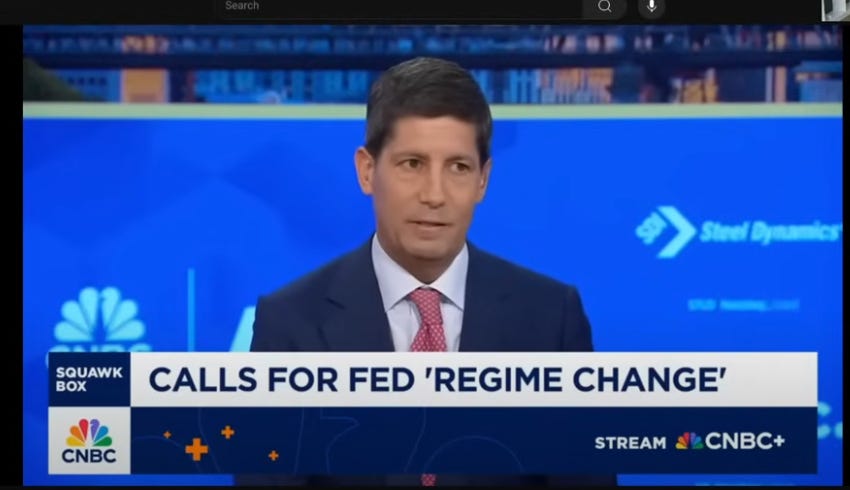
He says:
The Fed has no credibility
The Fed isn’t fully independent
Inflation is caused by printing money.
If this is what we are seeing in public view, the political machinations going on behind the scenes must be truly groundbreaking – like, coordinating an Arab oil embargo to inflate the price of oil 400%, groundbreaking.
So, from the Trump administration we have gotten:
1. “Bitcoin is the new oil.”
2. The GENIUS Act stablecoin bill passed
3. A likely not-so-secret plan to grow stablecoin market cap and treasury demand by growing the bitcoin market cap.
4. Kevin Warsh saying publicly that the Fed has no credibility, the Fed isn’t independent, inflation is caused by fiscal profligacy and money printing, and that we need to enter into a new monetary regime.
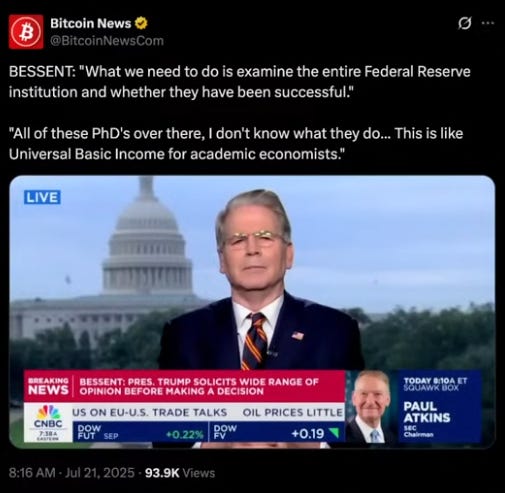
The message and the game plan at this point could not be more clear from the Trump administration regarding the Federal Reserve’s independence.
It is this: If you try to cockblock our agenda, we will publicly destroy you and your credibility.
And if the public perception is that there’s “no credibility” at the Fed, the Bureau of Labor Statistics, or any other entity, quasi-government, official, or otherwise, then it makes perfect sense and becomes perfectly palatable to the public for those entities to be assimilated into the administration. If these entities actually had credibility before it would be a scary situation. But I have detailed here how government statistics have been massaged.9
Some official government economic statistics and targets have been bullshit for decades. But now, they’re only going to be bullshit in one direction. And anyone who doesn’t play along with Trump will get banished to the corn field.10
So what’s the endgame here? The endgame is to “re-marry the Fed and the Treasury,” as Jack Mallers puts it.
This will allow the administration to cut short-term rates close to zero, unlock all that Home Equity Line of Credit (HELOC) spending to give a boost to consumption, use that recent Executive Order to get 401K plans to have access to gold and bitcoin, keep tariffs, and lower the value of the US dollar relative to other currencies in order to make American goods cheaper to the world, pump real, scarce assets like bitcoin and gold so the inflation Americans mostly see is in those asset prices and not in eggs or gasoline. And even if eggs and gas go up 9% per year because of the coming Big Print, if your portfolios and 401K plans are up 65% because of stocks and because your trad-fi financial advisor’s Compliance department recently allowed him to recommended a 5% allocation to bitcoin, then people won’t complain. In fact, a whole lot of voters will celebrate. Congratulations, Mr. President. You just figured out a way to make inflation politically popular.

So, “Re-marry” implies there was a Fed-Treasury divorce?
If you asked yourself that question, give yourself a pat on the back, because you’re a smart cookie! Yes. They were “married” before. The “divorce” was the period of Post-WWII “Fed independence” that really only started in 1951 with the Treasury-Federal Reserve Accord.11
There had been a courtship going on since about 1913, but for our metaphorical purposes, the Fed and Treasury “got married” for the first time in 1941 when the United States entered World War II. And what happened when the Fed and Treasury tied the knot that’s relevant to us today?
Well, you can see in a chart from Luke Gromen via Jack Mallers here:
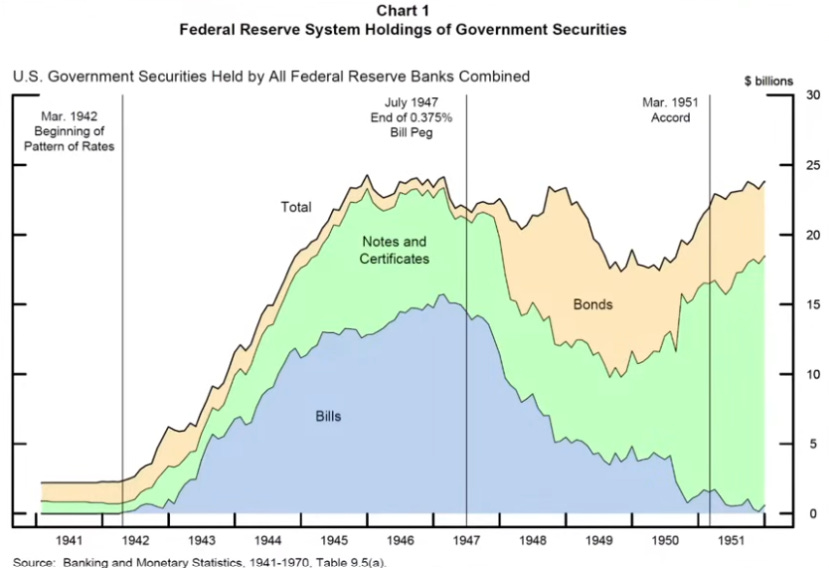
Treasury issuance – particularly in the form of short-term bills – skyrocketed.
If you aren’t inclined to believe a conspiracy theory-peddling guy like me, or Luke Gromen, or Jack Mallers, then maybe just look at the Fed’s and Treasury’s own sources.
One source explains to children the more than 5x increase of outstanding US debt during WWII:
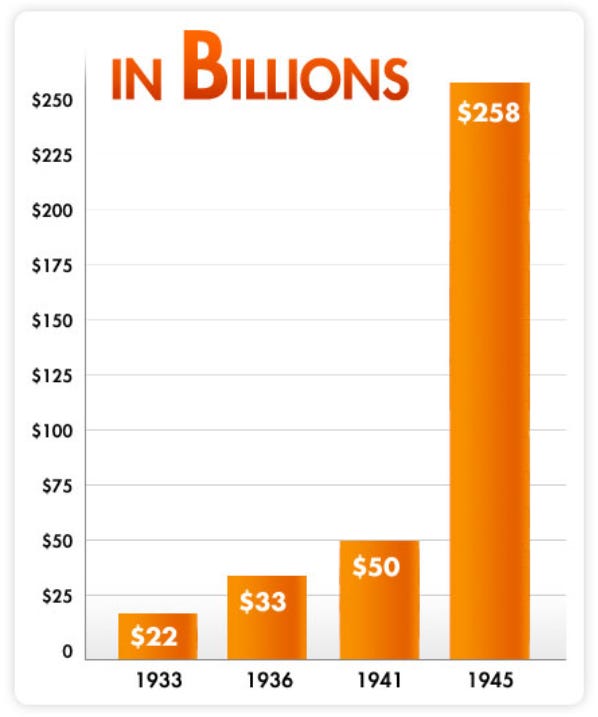
And one shows the increased use of short-term treasury bills with the Federal Reserve as the backstop for when public demand dwindled because rates had been kept artificially low (meaning real returns were quite negative).
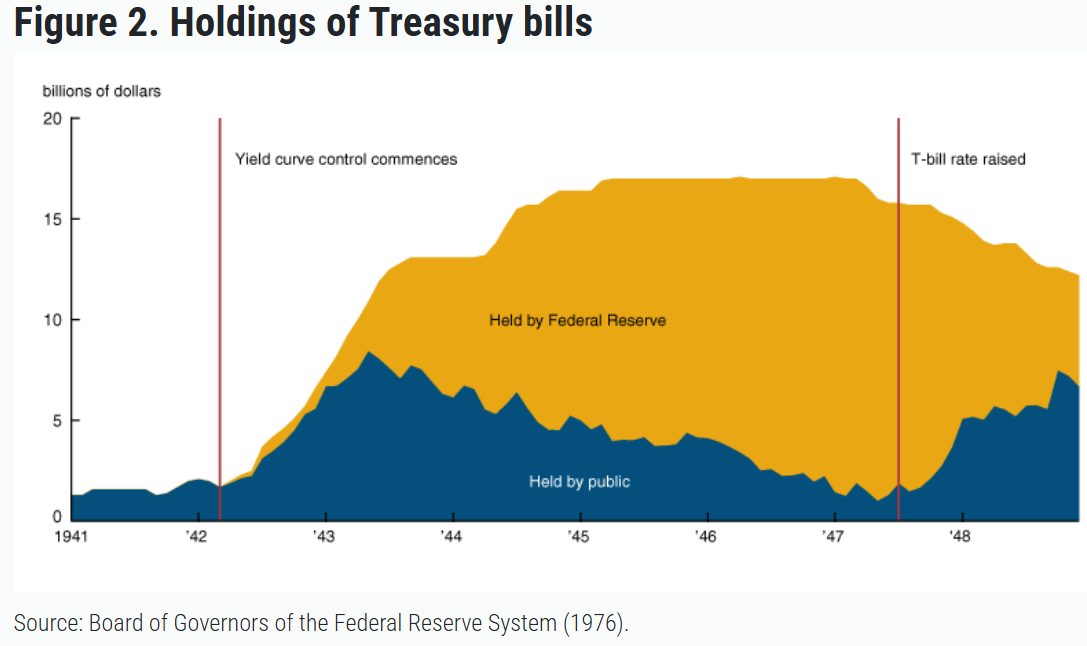
You can just eyeball it here, and it looks like Treasury bill issuance went from about $1 billion at the onset of WWII to about $17 billion – the math’s not too hard there and it’s about a 17x increase.
And then you remember that Scott Bessent said he thinks stablecoins can grow to $3.7 trillion.12
Estimates vary, but the current stablecoin market cap is about $278 billion. The two biggest players, and the only ones that really matter for now are Tether (USDT) and Circle’s USDC. Combined, their market cap is about $232 billion.
So, WWII saw US debt rise by about 400% in a relatively short period of time. The 1970s saw the price of oil rise – again, quietly spearheaded by America – from about $1.80 a barrel in 1970 to about $11.60 a barrel in January 1974, an increase of about 544%.13
And now with statements made by the US Treasury Secretary, we can conclude that the plan is for stablecoin market cap to rise by about a factor of 13x – 16x.
The dots are all connected in my mind. It’s not a conspiracy theory. The quiet part is being said out loud for all to hear. You just need to be willing to listen. The potential ramifications of this all is pretty mind-blowing – especially when you realize that the fastest, least destructive, and most stable way to do this (for Americans at least, more on that shortly) is to massively expand the bitcoin market cap.
Tether and the Elimination of the Middleman
At this point, I want to get a little technical, but I do not want to get too shitcoiney. Still, it’s important to understand how stablecoins like Tether or USDC get created.
For simplicity’s sake I’ll just deal with Tether. As noted before, it is the company that issues the stablecoin USDT. Each USDT is backed by one actual US dollar worth of assets.14 As discussed above, that mostly means US treasuries. USDT can be issued on any blockchain that Tether the company has chosen to run on. Tether supports multiple chains, including Ethereum, Tron, Algorand, and this year, integration with the Bitcoin Lightning Network was announced.
The problem here is that if your USDT is acquired on the Ethereum network, you actually need to acquire ether (ETH) to move your USDT in order to pay for something or trade it against something else. Someone can send you USDT over the Ethereum blockchain and it’ll show up in your wallet. But it will just be stuck there unless you buy ETH to pay for the fees needed to transact on the Ethereum block chain. These are gas fees, and they can get expensive in times of high demand.
This has led to competition in the shitcoin blockchain space as Tron and others have touted their lower gas fees as a reason people should acquire USDT on their chains rather than over Ethereum. Last I heard, in Argentina Tron is the dominant chain for USDT transactions, though that is probably outdated information by now as Tron gas fees have been rising significantly.
Here’s a snapshot of what it costs to transfer some USDT on various chains:
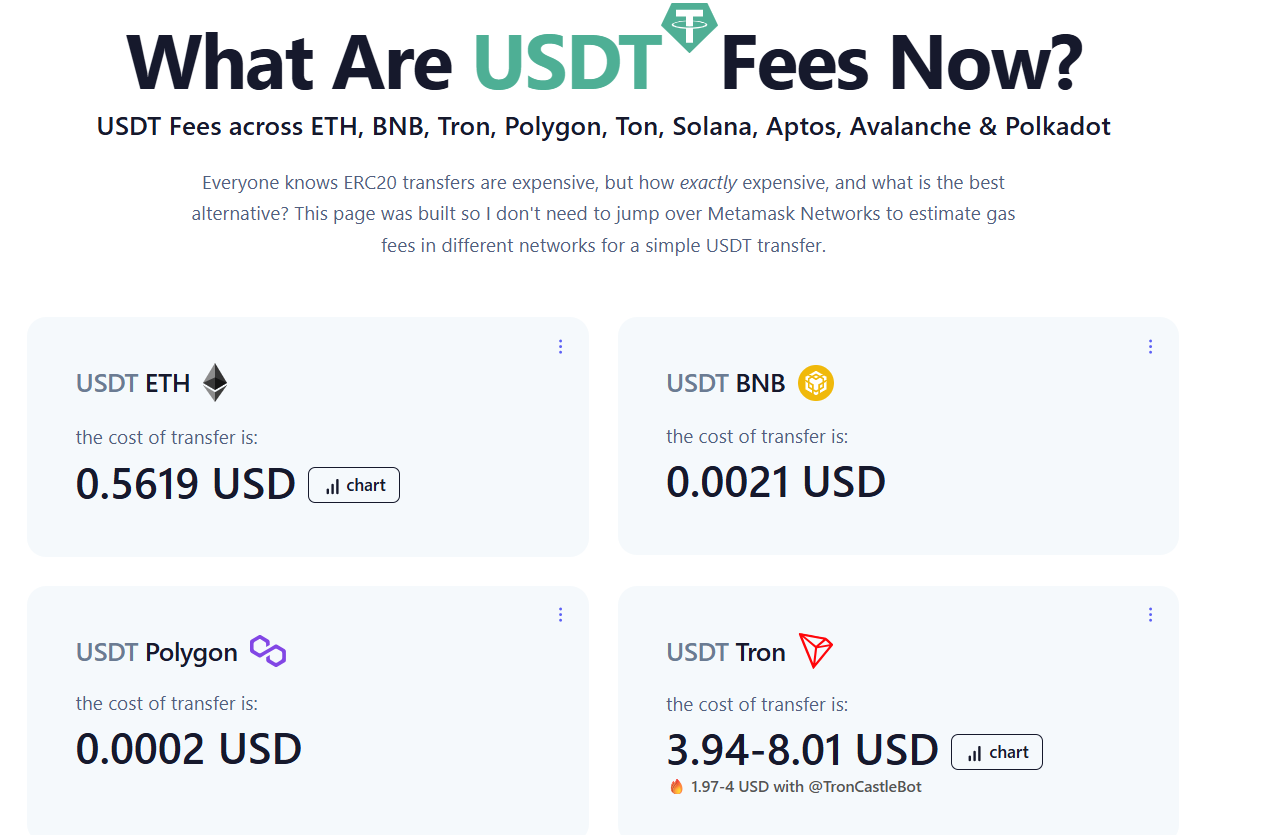
Ok, that’s enough shitcoin talk. The point of me bringing it up is to show you that this is a major gravy train of a money maker for these shitcoin chain companies if they can snag any sort of market share for the USDT transaction volume.
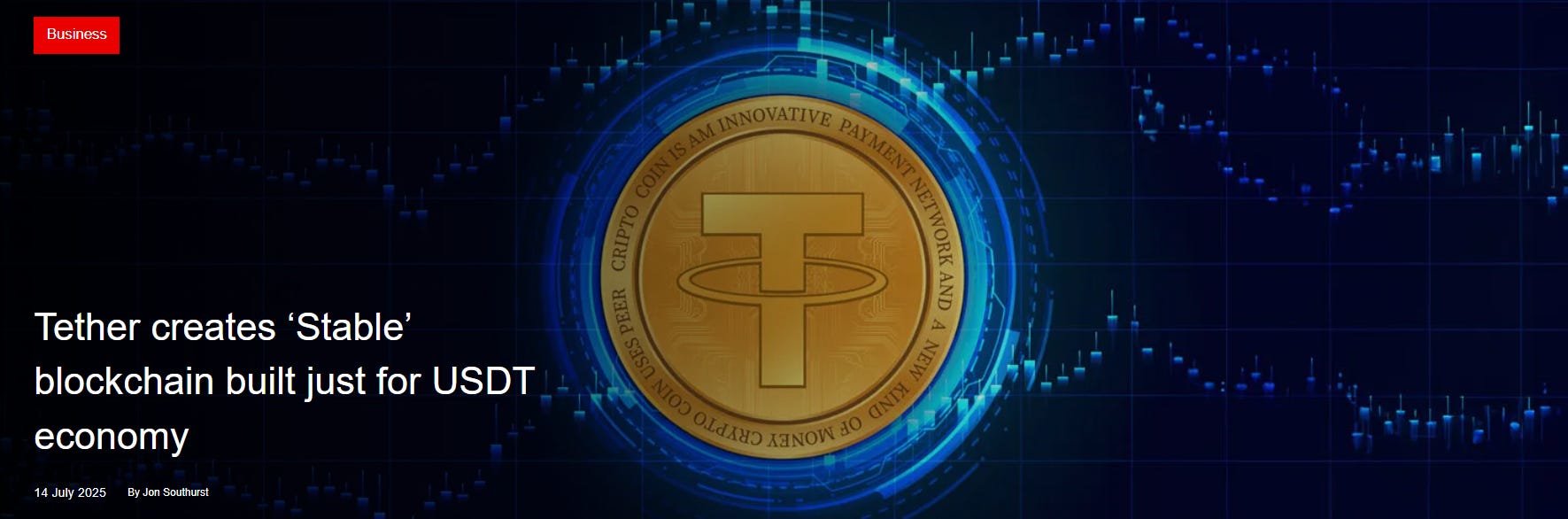
Tether the company is well aware of this. And they know that the elimination of middleman chains could save users billions of dollars and make adoption of USDT even more attractive for those just needing access to a digital form of the dollar.
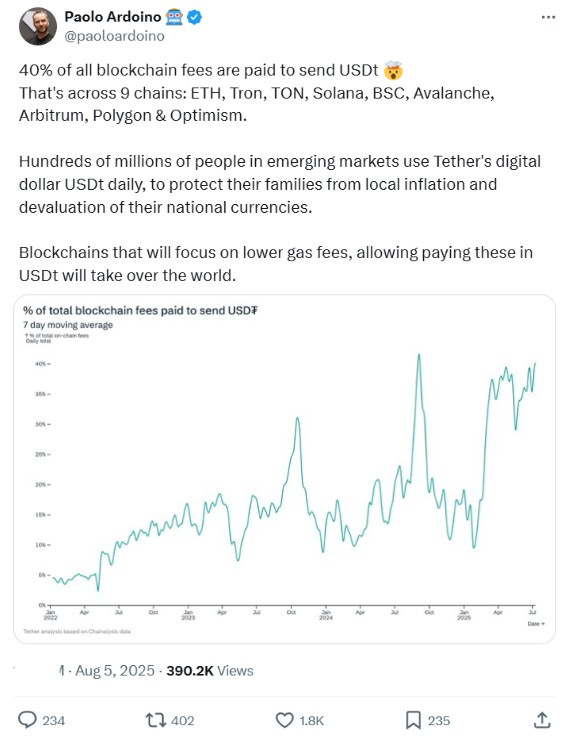
Tether CEO Paolo Ardoino is no idiot. Tether the company was more profitable than BlackRock was last year. And they did it with like 75 employees. They have expanded to about 200 now. This is an insanely profitable private company.
Paolo knows that if he could start his own blockchain just built for the USDT economy – meaning USDT is the native currency/token of the chain where transaction fees are paid in USDT rather than some shitcoin started by a guy who paid $6.2 million for a banana duct taped to a wall, then Tether could drink the milkshakes of a whole lot of shitcoin CEOs.
And why wouldn’t he drink those milkshakes?15 If one major use case of USDT is to throw a life raft to the developing world, to help give relief to Argentines buying lunch at empenadas stalls, and Nigerians, so dependent on imports and overseas remittances from family members abroad, and Lebanese paying monthly medication bills or insurance premiums priced in US dollars, so they don’t have to fear that the purchasing power of their savings will evaporate, then it only makes sense that Tether would try to give as little a cut as possible to a guy like this:

So this is exactly what Tether is doing, and the fees for transacting USDT will likely fall over time.
“USDT tokens exist on multiple blockchains. Most Tether “lives” on TRON (TRC-20), which accounts for around 37% of the total supply. Ethereum (ERC-20) is just behind that with ~31%, and there are smaller shares of USDT on Polygon, Solana, Avalanche, and BNB Chain (as well as several others). Though exchanges will generally allow USDT holders to withdraw on any network they choose, you can’t send ERC-20 Tethers to a TRC-20 address without using a “bridge” between networks, and having the know-how to do so. The same situation applies to USDC.
Tether transactions make up a large proportion of network traffic on these blockchains, particularly TRON—it’s more than half of TRON’s total transaction volume. A native USDT token also works as a marketing and credibility boost for these networks, attracting users and developers who may want to try their other features. For example, TRON’s USDT traffic share largely results from being faster and cheaper than Ethereum, while USDT on Ethereum attracts DeFi builders/traders and token creators. If Tether and other stablecoins move to their blockchains, those blockchains may start to lose their appeal.”
Remember the highlights I added to this excerpt before you think about throwing any of your money at some ETH or TRON “Treasury company.”
So, the basic mechanism for how stablecoins work is now set up. Now, the wider ramifications.
Tether As “Parastatal Dollar” and Interaction With the Banking System
There was a great, short article I came across on Nostr a couple weeks ago called:
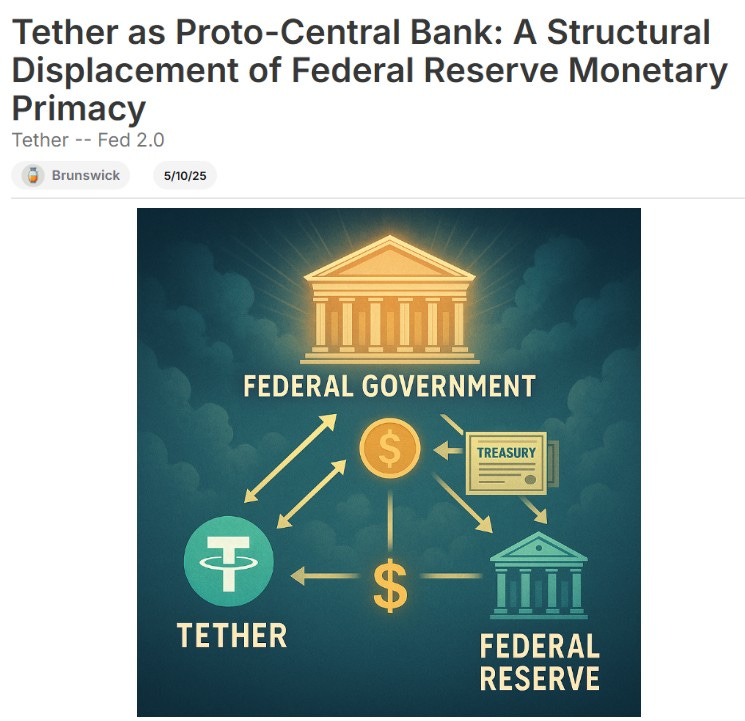
In it, Brunswick states:
“Tether (USDT), as a private issuer of dollar-denominated tokens, mimics key central bank behaviors while operating outside the regulatory perimeter...These tokens circulate globally, often in jurisdictions with limited banking access, and increasingly serve as synthetic dollar substitutes.
If USDT gains dominance as the preferred medium of exchange – due to technological advantages, speed, programmability, or access – it displaces Federal Reserve Notes (FRNs) not through devaluation, but through functional obsolescence. Gresham’s Law inverts: good money (more liquid, programmable, globally transferable (USDT) displaces bad (FRNs) even if both maintain a nominal 1:1 parity.”
So far, so good. This makes sense. It’s not hard to see how Tether or any other stablecoin could have a technological advantage over the traditional US dollar – especially when considering international transactions and transfers. But stablecoins’ potential interaction with commercial banking is where it gets really interesting and into the weeds.
“[C]ommercial banks issue loans denominated in U.S. dollars, expanding the money supply... If borrowers repay in USDT instead of FRNs:
- Banks receive a non-Fed liability (USDT)
- USDT is not recognized as reserve-eligible within the Federal Reserve System.
- Banks must either redeem USDT for FRNs, or demand par-value conversion from Tether to settle reserve requirements and balance their books…
Conversely, if banks are permitted or compelled to hold USDT as reserve or regulatory capital, Tether becomes a de facto reserve issuer. In this scenario banks may begin demanding loans in USDT, mirroring borrower behavior. For this to occur sustainably, banks must secure Tether liquidity. This creates two options:
- Purchase USDT from Tether or on the secondary market, collateralized by existing fiat.
- Borrow USDT directly from Tether, using bank-issued debt as collateral.
The latter mirrors Federal Reserve discount window operations. Tether becomes a lender of first resort, providing monetary elasticity to the banking system by creating new tokens against promissory assets – exactly how central banks function.”
Reading through this article, one can easily see how Tether or any state-sponsored stablecoin could come to control the expansion of money through credit issuance, as their balance sheet “mimics a central bank, with Treasuries and bank debt as assets and tokens as liabilities.”
Brunswick also notes that Tether “intermediates between sovereign debt and global liquidity demand, replacing the Federal Reserve’s open market operations with its own issuance-redemption cycles.”
“Simultaneously, if Tether purchases U.S. Treasuries with FRNs received through token issuance, it:
- Supplies the Treasury with new liquidity (via bond purchases).
- Collects yield on government debt.
- Issues a parallel form of U.S. dollars that never require redemption – an interest-only loan to the U.S. government from a non-sovereign entity.
In this context, Tether performs monetary functions of both a central bank and a sovereign wealth fund, without political accountability or regulatory transparency.”
I can hear the wedding bells now. More than seven decades after the Fed and the Treasury got divorced, they are getting remarried. So speak now, or forever hold your peace.
Brunswick hypothesizes on the endgame in what he calls “Institutional Inversion and Fed Redundancy.”
His conclusion is that:
“This paradigm represents an institutional inversion:
-The Federal Reserve becomes a legacy issuer.
-Tether becomes the operational base money provider in both retail and interbank contexts...
-The dollar persists, but its issuer changes…
Unless the Federal Reserve reasserts control – either by absorbing Tether, outlawing its instruments, or integrating its tokens into the reserve framework – it risks becoming irrelevant in the daily function of money.
Tether, in this configuration, is no longer a derivative of the dollar – it is the dollar, just one level removed from sovereign control. The future of monetary sovereignty under such a regime is post-national and platform-mediated.”
All developments over the past few months, including Powell’s Jackson Hole speech, have led me to believe that the Federal Reserve will not reassert control. The Trump administration is making damn well sure of that with all of their efforts to discredit the institution in general and Jerome Powell in particular.
The one area of the entire post by Brunswick that I would take issue with is the absolute last line where he says:
“The future of monetary sovereignty under such a regime is post-national and platform-mediated.”
It’s true that stablecoins have brought about the nascent stages of a platform-mediated “parastatal dollar.” However, the passage of the GENIUS Act and other efforts are intended to make sure that this development is not, by any means, “post-national.” The United States is intent on having a hand in controlling a lot more than just the dollar.
“We need people to have a reason to own dollars to invest in the US”
This was a line spoken by Vince Lanci on a recent episode of the Coffee and a Mike podcast.
He goes still deeper into the weeds on another important fundamental aspect of the mechanics of what stablecoins are going to be used for.
“We don’t want them to sell their treasuries anymore. What stablecoins are, is like a new money market fund. You put money in a money market fund, and it acts like a savings account, but in reality when you want to take money out, say you want to buy a stock with it, they have to liquidate the fund, and they put the money into the stock the next day. It’s one day but it’s a big one day. It’s a big deal. You may remember, I think it was after the GFC we almost had our money market funds break. [So] pretend the money market fund is replaced with a stablecoin. And that stablecoin says you do not have to liquidate the money market fund to buy the stock. The stablecoin is a shell – it’s all about legal terms – the stablecoin is a shell and a contract. It guarantees what’s in it. And so we, instead of having to put treasuries into something [the money market fund], sell the treasuries to buy the stock, you put the treasuries in the stablecoin, it stays, and the stablecoin buys the stock.
Now, we may say, ‘What’s the big deal?’ It’s a big deal. Because you’re cutting 24 hours out of everything and it’s less risk for them. They don’t have to worry about taking $20 out of your bank account twice. That type of thing. It’s a contract. And so by doing that, you tell people…‘Ok, you have treasuries. You’re looking to sell them? Why?’ ‘Well, gold’s safer.’ Ok, fine. How about we let you keep those treasuries and we give you a piece of IBM, or Exxon, or [any] company. And they say, ‘Well, how can I do that?’ Well, you put your treasuries into stablecoins, the stablecoin buys a piece of Exxon, you now own a piece of Exxon in treasuries as your collateral, so the collateral doesn’t have to be liquidated. So, what does it do? It says to someone, I can own treasuries, and even though it’s not as safe, I’ll use my gold for safety. I’ll use the treasuries for my upside.
So you create demand for treasuries. And, take [those] treasuries – it’s really derivatives – you’re taking demand for treasuries and you’re parlaying the treasuries into companies. So you’re completely undermining treasuries as a safe haven – completely. You know, if stocks go down then treasuries get liquidated. It’s the opposite of what we’re used to. Stocks go down, everyone buys treasuries. It’s very bad in that respect. It’ll be another problem couple years from now.”
Note that sentence toward the end. “If stocks go down then treasuries get liquidated.” This will not be an anomaly anymore. This will be the norm – and all the more reason for the Big Print to come quickly if the plumbing of this system Lanci describes ever gets clogged.
Lest you think this is all hypothetical, it’s not.
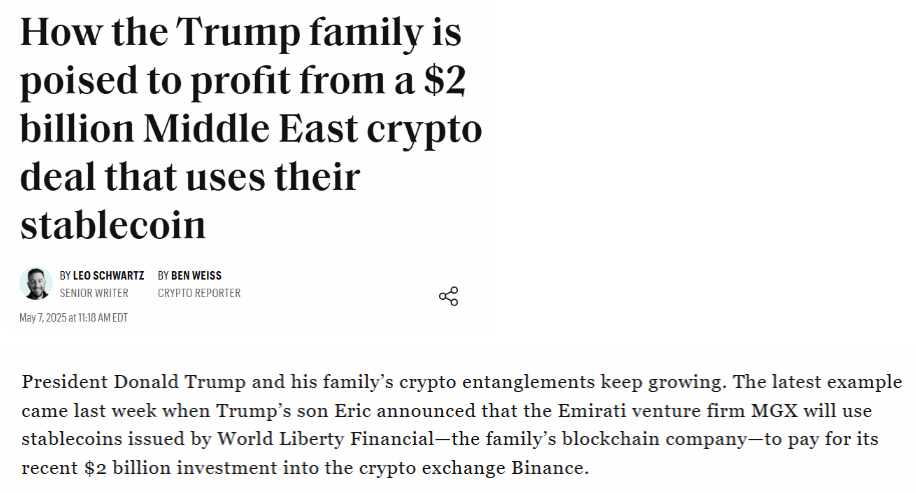
This transaction is quietly a very big deal that most people missed. This isn’t some random shitcoin play. Lanci calls it a test case, and that’s exactly what it is.
“A company called MGX bought the stablecoin, put their treasuries into the Donald Trump stablecoin to come to America and buy a piece of the Binance exchange. It’s a test case. That’s why Trump is pro-crypto. To line his own pockets of course, but also, you remove the need for a bank. I put my treasuries in the stablecoin. The stablecoin is the contract, it’s like a lock box, and I can take the stablecoin and buy American companies with it. Trump just did that. We’re doing that. That’s part of the deal.”
And then Lanci brings it all full-circle (edited for clarity).
“[It’s like] when the petrodollar was invented...Make everyone buy oil in dollars and you can put the money in treasuries...What they’re doing is they’re finding another “country” to buy treasuries, and that other country is the United Nations of Stablecoin. And they’re going to hold treasuries and buy our stocks. It’s another fucking bubble. And there’s another precedent for this. In 1982, Ronald Regan did this...What Reagan came along and said is, we need more people to buy stocks. Change the tax law, let insurance companies start offering variable annuities and more aggressive things. And what happened? Over the next five years, everyone went into stocks. And in 1987 we had a crash. This is probably what’s going to happen here... You can distrust it. And you can definitely not look at it as a store of value if you’re a gold person. But it’s not going away, and twenty years from now if it hasn’t blown up, your kids will be using it like you use a money market fund.”
I can hear one objection now. Money market funds pay interest, while stablecoins don’t and legally can’t according to the GENIUS Act. Well, when Trump is able to get rates down (at least close) to zero, then there won’t be much of a functional difference now, will there?
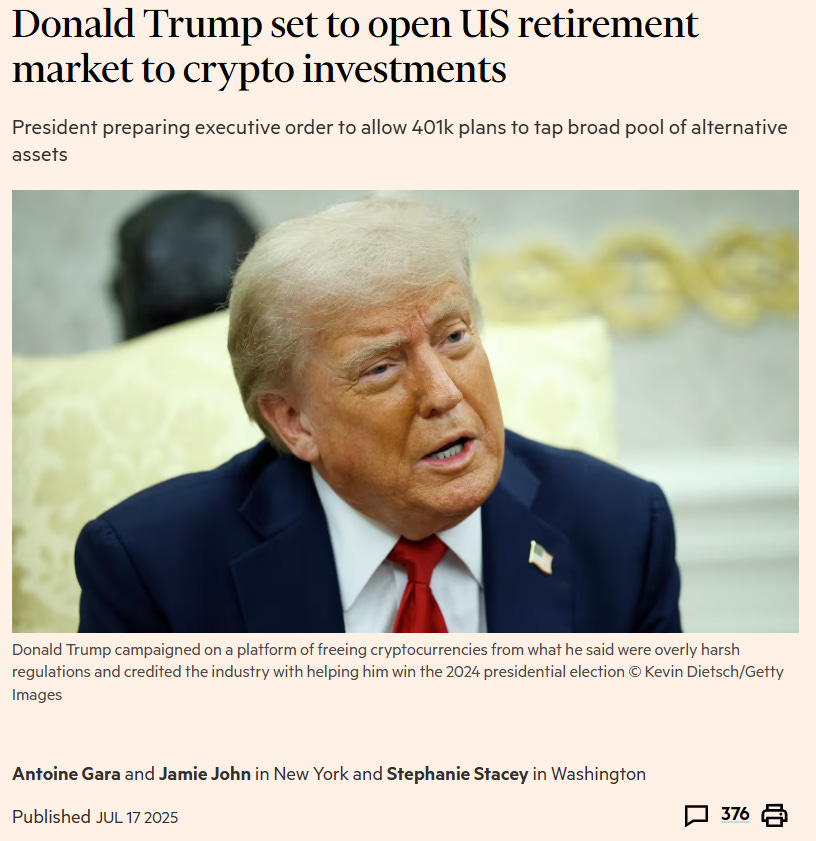
Again, no crazy conspiracies here. Just connecting dots – some more visible than others. But it seems clear that Trump knows the Big Print is coming. He knows because he’s a part of manufacturing it. The dots are all connecting. Relaxing rules around the Supplementary Leverage Ratio allowing US banks to hold unlimited amounts of US treasuries, the GENIUS Act, the eventual establishment of a Sovereign Wealth fund, the Trump organization literally doing deals facilitated by stablecoins, and Trump signing an Executive Order to open up America’s retirement accounts to what some might call high-risk, “low-transparency” investment vehicles.
And there’s one last dot to connect.
Marty Bent and Darkside Scott on Global Political Instability
One final podcast that warrants your time is a recent episode of Marty Bent’s TFTC: A Bitcoin Podcast. Episode #643 with “Darkside Scott” @DarkSide2030_ that I mentioned in a writing here.
The host, Marty Bent sets up a troubling, but likely scenario (edited for clarity):
“Maybe it’s like, the second order, sort of, destabilization effect is intentional in the sense that, if you, and this is where we get like Alex Jones, like con[spiracy], like, this is, anybody listening, this is just a theory, but it would be pretty interesting. It’s like, you get the stablecoins out there, you destabilize and a parallel on the back end, as a government and as a country, individual citizens within that country really leaning into bitcoin...
And if you’re the US government acknowledging, like, ok, it seems pretty clear, the writing’s on the wall, that the US dollar as a reserve currency, it’s on its way out. Like, how do we extend the American empire into the future? It’s like, you push the dollar, destabilize everything else, get them all pissed off at you, but then on the back end, accumulate as much bitcoin as possible, and be like, ‘Ok, we’ll go to this neutral reserve asset, and by the way, we’ve accumulated a bunch and our country is going to be on good footing coming out of this.’”
Darkside Scott responds:
“Yeah, I think that’s a very reasonable take, albeit for me to take off my tinfoil hat, I tend to like to wear it, but yeah, I think that if I listen to the administration closely, what they’re saying is they want a devalued dollar. At the same time, they want dollar dominance to increase. And those two things would seem antithetical to each other, but if you look through the clouds, I think you see that stablecoins can accomplish both...But again, I get concerned when we begin to meddle in foreign affairs to this degree.
You know, you’re going to remove the foreign governments’ ability to manage their currency, and you’re going to push dollars into the wild in all types of countries all over the world. What is the second-order effect? It scares me. I think it’s inflationary. You know, obviously we’ll export as much of that inflation as we possibly can, but again, how much can you mess with the rest of the world before it comes back and hits you in the head? I don’t know the answer to that question, but it would seem that that’s where this is headed.”
And just like that, all the dots are connected in my head. I’ll keep it simple…
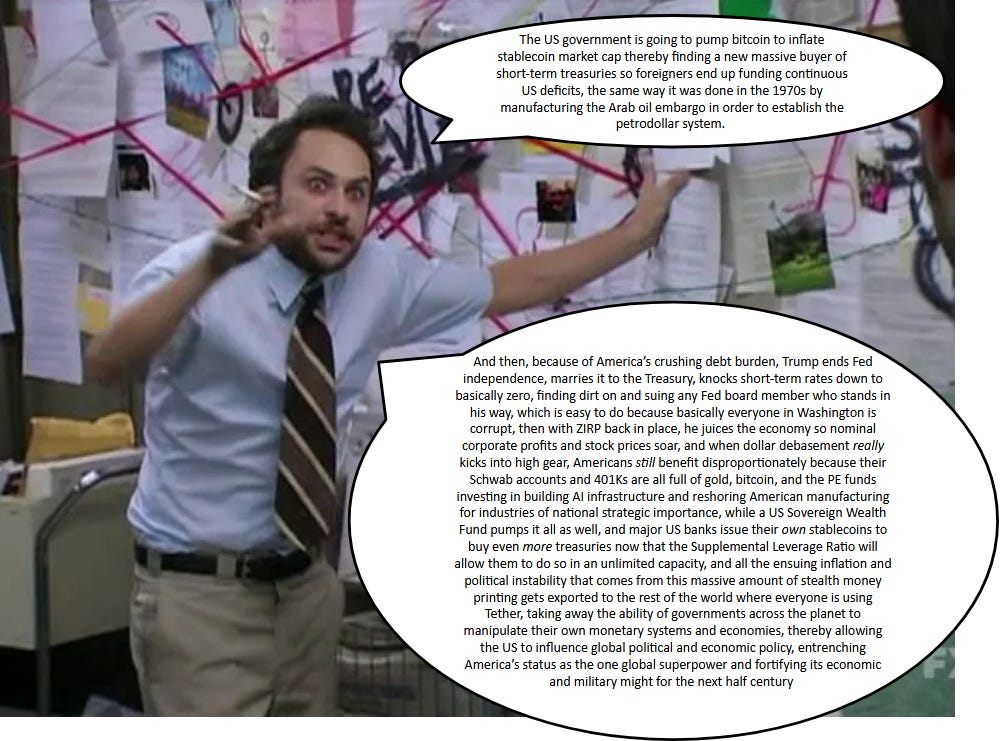
“Well, that was one crazy-ass deep dive. So how the hell do I benefit from all this?”
A few ways.
1. Give a fair hearing to “conspiracy theories.” Get your bullshit meter in order to tune out the ramblings of the hopelessly gullible and the insane. But keep your eyes and ears open to make connections between the seemingly unrelated dots if you suspect a grander scheming. The ideas may be on the right track and you can seriously benefit if you think, live, and invest “as if” they are true before conclusive proof is available. Again, rich and powerful people have been known to conspire. There are even meetings where “power brokers” get together and discuss God knows what. They happen at places like the Bilderberg Hotel, Swedish island resorts, Bohemian Grove, and at any other place where the totally not Satanic shadowy elite groups of pedophiles meet.
2. Understand that stablecoins are almost surely here to stay. Companies that use and develop this technology – which helps the US government in its efforts to reorder the global trade system, rejuvenate American economic might and its geopolitical aims – stand to benefit significantly. This likely includes companies like Circle Internet Group (CRCL), the second largest issuer of stablecoins after USD Tether with USDC. This likely includes the major US G-SIB banks16 that in the very near future will almost surely start to issue their own versions of stablecoins backed by their holdings of short-term US treasuries. Can JPMorgan Dollars, Bank of America bucks, and Wells Fargo Coin be that far off? Probably not. And even though I hate with a passion almost everything about banks, stocks like JPM, BAC, and WFC will probably do quite well under this new monetary regime.
3. Money transmitters, both for international remittances and US domestic value transfers and payments processing that are embracing stablecoins and bitcoin will also likely have an edge over the legacy companies. The cost to send money in the form of US “dollars” to then get exchanged into local currency to family members in Guatemala, Lebanon, Nigeria, the Philippines, and all over the developing world, will plummet. I once heard Harry Sudock of CleanSpark refer to Western Union as, “A vampire standing on the neck of the internationally disadvantaged.” Unless these companies radically change the way they do business, companies like Remitly (RELY) embracing stablecoins and SoFi Technologies (SOFI) utilizing Bitcoin’s Lightning Network to facilitate payments, will be drinking Western Union’s (WU) milkshake right down to the bottom of the cup. Jack Dorsey’s Block (XYZ) seems to be educating businesses and individuals on bitcoin “the right way,” and Block should do well also.
4. Study bitcoin – real bitcoin. Learn how to hold it in self-custody so you don’t have to worry when the government – any government – tries to “6102” you.17 And when you study it for long enough, I think you’ll start to realize, that ETFs, meme coins, and even “bitcoin treasury companies” are a distraction. You can profit from them all. But it’s all noise. Freedom tech that builds on top of bitcoin to globalize the concept of David Chaum’s “Untraceable Electronic Cash” is the signal.18 It has been said that bitcoin is a monetary revolution disguised as a get-rich-quick scheme. The incentives of prosperity and freedom actually align, and that is the “sly roundabout way” to introduce something that “They” can’t stop.19
Privacy and free speech are both necessary prerequisites for democracy to work. We have curtains on our voting booths for the same reason we have them in our homes – to avoid the information contained therein from being used against us by evil people trying to harm or take advantage of us.
And if your speech is censored, or the ideas you’re allowed to encounter are manipulated, then you are not a free person. You are just someone else’s tool that is being manipulated in order for them to achieve a self-serving political or economic goal.
5. Don’t let “THEM” drink your milkshake. Prepare now to insulate yourself, your family, friends, and local community against that kind of subtle theft. Sound the alarm as best you can to help as many people as possible understand what is going on. Help them connect the dots even if it only clicks for them in the future and they call you crazy now.
Hold on to assets quietly. Narcissistic social media posting puts a target on your back. And if you’re in a situation where the assets you hold are so in demand that “They” will stop at nothing and even destroy society in order to get them, make sure you set yourself up in a way that gets you through to the other side. This is not conspiratorial thinking. It has happened before. At its heart, Socialism with a capital “S” is just institutionalized envy, and Communist revolutions are the enforcement of that envy in order to make a land grab and steal your property. It will happen again, and things will go south pretty quickly. But even then, I have hope. People adapt.
Black Pill To Orange Pill
I honestly don’t know how to feel about all of this. I have laid out the way that I think the United States will secure its status as the preeminent economic, cultural, and military force on the planet for potentially the next fifty years. This is how the Empire perpetuates itself. But I don’t find joy in this. That the absolutely broken money of this hegemonic superpower could dominate the world for as long as it has speaks volumes to how pathetic and broken the rest of the world really is. I’m sorry to be blunt but it’s true. All empires eventually fall, but they can sputter on for centuries longer than the right-but-early doomers think.
US financial control does have limits though. How many people have to get burned by frozen accounts or transactions before they realize that bitcoin is the only true path toward freedom – the only form of money that can be transferred across the planet to anyone without needing the permission of a middleman, corporation, or government? At the end of the day, it might make sense just to get some in case it catches on.
After the 1970s, the post-Arab oil embargo world was a changed place. America and the world had to learn to live with inflation. This was just the economic and mathematical reality of living in a purely fiat-based monetary system. The oil embargo just gave cover to the politicians looking for excuses and to lay blame for the inflation that, at the end of the day, was caused by nothing more than printing money.
But because the black gold that is oil became so expensive, it made a lot of oil companies and executives and shareholders and politicians very wealthy, as searching for and producing oil in new areas suddenly became profitable. This eventually lowered America’s dependence on foreign countries for its energy needs, and it has had massive national security ramifications that have reverberated across the globe – for America, and particularly for Europe. The European attendees of that fateful 1973 Bilderberg Group meeting worried about this more than half a century ago. America did something about it, while Europe, from a long-term perspective, completely dropped the ball.
These political machinations, no doubt conspired on in cigar-smoke-filled rooms in 1973, solidified America’s place as a global superpower for half a century – and because Communism is such a pathetically awful system, for the last 35 years, America has been the only global superpower. But that status is not guaranteed in perpetuity. The powerful can’t rest on their laurels, grow fat and lazy, and expect to retain their power and influence for long.
The Arab oil embargo gave a modern blueprint for how an American administration can “solve” an impending debt crisis without a World War. Stablecoins are the technological tool that allows them to do the same now. It is the ultimate can-kick down the road. It is only a half-measure, but it will work for now, as billions of people from Nigeria to Argentina, Turkey to Columbia, Asia and the Middle East will soon be downloading apps on their phones, acquiring some Tether, and seeing that it “goes up” in value vs. their shitty local currencies.
But how long before those same exact people realize that another easily-acquired digital asset – one that even Donald Trump can’t print – “goes up” even more in value than does Tether? At the end of the day, what an American administration of trad-fi-minded stablecoin purveyors knows – the quiet part that I and many others have been saying out loud – is that, while stablecoins are the answer to a lot of our immediate financial problems, they are still based on a fully fiat-based dollar. Digital dollars, tokenized greenbacks, stablecoins, whatever you want to call them – if we’re being honest, we would call them “guaranteed loss of purchasing power tokens.” But that’s a mouthful and a euphemism. And I hate euphemisms, as I’ve said before. If we’re using simple, honest, direct language, let’s call them what they are – shitcoins. And bitcoin – eventually – solves this.
❤️ “Like” and share this post to conspire with others to spread dangerous missed information.
That 6-month timeline is only made possible by the advent and subsequent ubiquity of social media. In the case of the JFK assassination it took about 60 years before mainstream opinion believed, with any amount of conviction, that the official accounting of the events that took place was complete bullshit. Unlike many people my age, I love so much about the Baby Boom generation, but Jesus Christ they are so foolish when it comes to believing mainstream media narratives (aka propaganda) and taking them at face value.
Though if there is a Satanic shadowy elite group of pedophiles in the world, some of them have probably attended a Bilderberg Group meeting or two.
And just by sheer coincidence some of them may have happened to be part of a Satanic shadowy group of pedophiles, but I have no proof of that, and I digress...
A disparaging term coined by Victorian novelist and playwright Edward Bulwer-Lytton referring to the common or lower classes of society. The hoi polloi of Classical Greek, if you will. It shows that regarding our modern social ills and elite attitudes towards the common man, notwithstanding a few digital novelties, there really is nothing new under the sun.
https://en.wikipedia.org/wiki/Limited_hangout
Americans don’t need USD Tether because they already have access to dollars. This is why I roll my eyes when trad-fi macro analysts trying to be tech savvy or anyone like Paul Krugman writes things like, ‘There’s nothing you can do with [stablecoins] that can’t be done more cheaply and more easily with debit cards, Venmo, Zelle, wire transfers, etc. That is, why not just use dollars instead of tokens that are supposedly backed by dollars?”
Yeah, no shit, Sherlock. Even with this obviously correct point that Krugman seems to think is a flex, he still gets it wrong, at least about the wire transfers. Try wiring money to El Salvador, Argentina, Turkey, or Lebanon, or even Milwaukee from Western Union or your local bank branch on a Sunday afternoon. Then maybe tweet at Professor Krugman on how it goes for you.
By “massaged” I of course mean “manipulated” – but that would make me sound like a conspiracy theorist. Though if you read my post “Boskin’s Robbins” you might not hesitate to use more loaded adjectives in your thinking as well. CPI is manipulated in order to keep cost of living adjustments (COLA) and increases to benefit payments lower than the increases to the citizenry’s cost of living. Simple as that.
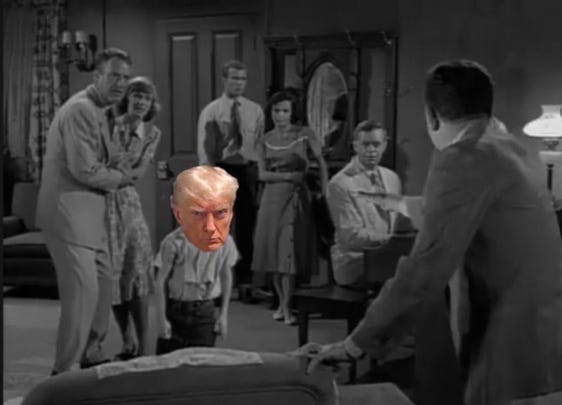
One of the best episodes of The Twilight Zone television show, and a dark commentary on the grinding mental misery of living under a tyrannical ruler. I am not saying that Trump is a tyrant. I just liked the meme potential of the pop culture reference for Season 3 Episode 8 of the show.
https://en.wikipedia.org/wiki/It's_a_Good_Life_(The_Twilight_Zone)
The source of this $3.7 trillion number turns out to be from a Citigroup report on stablecoins that puts stablecoin market cap at $3.7 trillion by 2030 in its bull case scenario. Their base case is $1.6 trillion.
Website shows Historical Crude Oil prices, 1861 to 2009 with data sources:
1861-1944 US Average
1945-1983 Arabian Light posted at Ras Tanura.
1984-2009 Brent crude
Unless you’re one of those Tether Truther conspiracy theorists who thinks it’s all fake.
“I drink your milkshake.”
G-SIB = Global Systemically Important Banks, i.e. The too-big-too-fail banks, and a perfect example of an abbreviation being the last stage of euphemistic obfuscation that I opined upon here.
https://www.fsb.org/2024/11/2024-list-of-global-systemically-important-banks-g-sibs/
Executive order 6102 was the one where Franklin Roosevelt basically stole everyone’s gold. It forced Americans to turn in their gold in exchange for $20.67. FDR then promptly revalued it by almost 70%. That would be like them taking your gold oz. Coin today, giving you $3,400 for it an then once they got it all in their own vault, saying, “Ok, now its worth $5,750.” Or if you want to think about it in a more accurate way, just flip your thinking about the denominator in this equation. This was a devaluation of the dollar and for all intents and purposes a sovereign debt default by the United States of America.
In regards to confiscation, it doesn’t have to be your own government that does it. It could just be one you’re traveling to if they know what you own. When push comes to shove, you basically have no rights when you’re dealing with a customs officer that is dead set on looking at the contents of your phone.
“Untraceable Electronc Cash” by David Chaum, Amos Fiat, and Moni Noar. You can read the paper here:
From Friedrich Hayek’s famous quote:
https://quotesonfinance.com/quote/118/friedrich-a-hayek-take-money-out-of-the-hands-of-government
Fascinating read—your exploration of stablecoins as geopolitical instruments really resonates. I recently published a short-piece arguing that dollar-backed stablecoins are becoming a form of digital soft power, subtly extending U.S. influence into fragile economies. It’s striking how blockchain infrastructure is reshaping global monetary dynamics without traditional intervention. Appreciate the depth you brought to this topic.
https://divistockchronicles.substack.com/p/stablecoins-the-next-evolution-of