
Boskin’s Robbins
Think Tank Sub - Weimar Vibes

The Consumer Price Index (CPI) number that financial market practitioners hang on every month in order to speculate about where Fed policy is going is complete bullshit, and using CPI or any other Bureau of Labor Statistics (BLS) tweaking of it as a proxy for “inflation” to make investment decisions without first doing some serious mental adjustments is a path to becoming poorer in real, purchasing power terms. Conversely, knowing how and why the BLS bullshits you, making those mental adjustments, and investing accordingly is a (potential) path to preserving and growing your wealth over long periods of time.
I say “potential” path because you still have to make the correct mental adjustments, and those are not always easy to figure out.
To give you an idea of just how much bullshit the BLS has been feeding us, I had originally intended to write an in-depth critique of the Boskin Commission report from 1996. I read every word. It’s boring but still interesting – I have highlights and notes all over the margins of the 40+ page report – because it so brazenly flies in the face of everything we intuitively know about the cost of living, how it gets harder and harder each year to make ends meet for the average middle class person, and how people seem markedly worse off in today’s America than they were, say, 40 or so years ago.
How can we judge “better off” though?
Well, the Boskin Commission report uses all sorts of things to judge. It refers to them as biases in regards to “quality change” and “substitution” and “new product bias” to say you’re better off even if the nominal prices you pay keep going up (while your income usually doesn’t, or at least doesn’t keep pace).
I’m generalizing here, and the dollar amounts are made up, but substitutions in the real world refer to situations like this:
The money you budget for food is, of course, limited by your income level.
You like to eat meat, as most omnivorous animals do.
And you used to buy steak because you like it, it cost you $20 and you could afford it. But now, after a few years of government money printing, the same steak costs, say, $30.
Everything else in the grocery store is also up around 50%, (your salary is up maybe 12%) and so you can’t afford a $30 steak now. So you buy that factory-farmed chicken instead because it only costs $18.
You substituted that nice healthy $20 (now $30) steak for an $18 KFC-Animal-51-style abomination, and voilà, CPI meat prices just went down by 10%.
There are also hedonic adjustments – basically the idea that the more pleasure (think “hedonism” for the root of that word), enjoyment, or utility you get out of a product can offset the nominal price increase (i.e. how much comes out of your wallet or goes onto your credit card).
Your washing machine has more buttons and cycle choices on it, so even though you just use it to wash your dirty clothes, the same way your Mom, and Grandma have since 1977, you’re getting more value for money.
So the “price” that goes into CPI calculations can go down because the value you get more than offsets the extra money you spent to replace your old washer that just broke down two days after the warranty expired – an example of “planned obsolescence” if there ever was one…
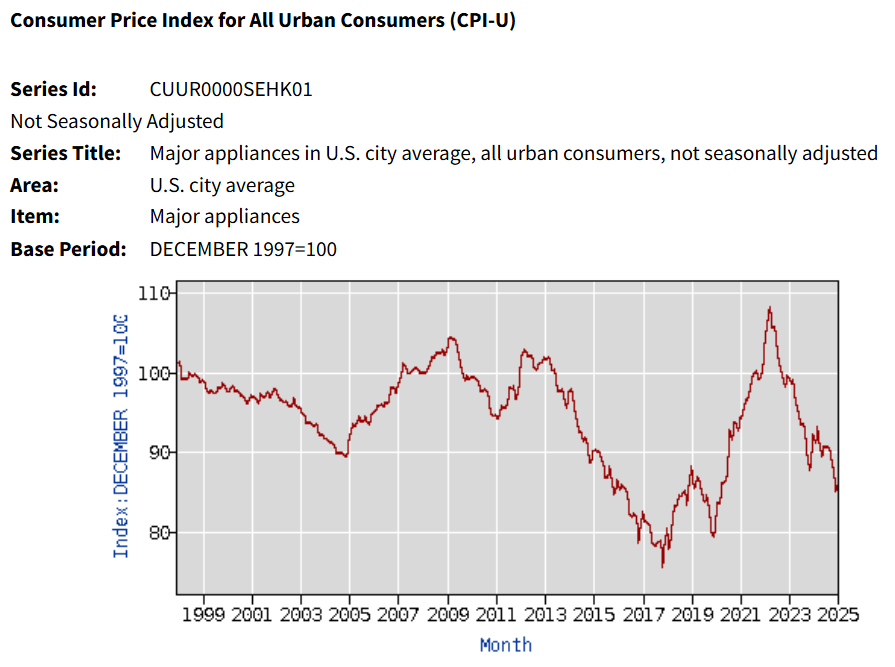
Source: https://data.bls.gov/timeseries/CUUR0000SEHK01
Yes, of course, technology is deflationary, but does anyone believe that “major appliances” in the United States have gone down significantly in price in the past three years? With 1997 (just after the Boskin Commission report) set to 100, the highest reading was April 2022 at 108.206. The latest reading in 20.6% lower at 85.896.
I’m going to go out on a limb here and say that what it costs you to replace the “major appliance” you bought in April 2022 will not cost you 20% less right now.
And again, of course, big flatscreen TVs cost way less than they used to. I repeat, technology is deflationary. That is the natural state of a free market. Read Jeff Booth’s “The Price of Tomorrow” or listen to any of his dozens of podcast appearances to hear that topic discussed way better than I can do it justice.
Source: https://www.jeffbooth.ca/
But the benefits we get from technology making things cheaper is more than outpaced by the inflation caused by money printing – which conveniently keeps the (nominal) earnings of companies listed on stock markets beating Wall Street analyst expectations quarter in and quarter out, keeps tax receipts from those (nominally) profitable companies flowing into the government coffers, keeps the government’s debt/GDP ratio looking manageable, and keeps all those American IRAs and 401-K accounts, housing prices and the increased property taxes that result from higher “valuations,” looking good.
Until it gets out of control. And when it gets really out of control, governments and central bankers around the globe have to try and control you. But before that, before it’s a necessity and while still not politically feasible, they just bullshit you.
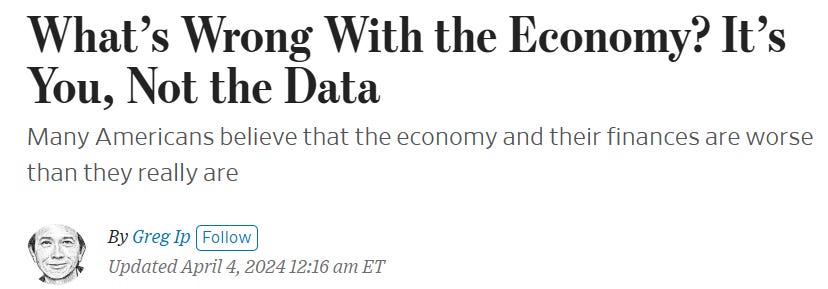
And they make it so that all the reputable people on network news channels and in the mainstream financial press tell you that inflation doesn’t exist, or that it’s a negligible 2%, or that if it is higher than that in some areas of the economy, it’s actually your fault. That infamous Wall Street Journal headline says it all.
Source: https://www.wsj.com/economy/consumers/whats-wrong-with-the-economy-its-you-not-the-data-cfa911e6
This is what the Boskin Commission did.
It gave serious academic credence to the idea that prior changes in the CPI have “substantially overstated the actual rate of price inflation.”
You read that right. It says that CPI has an “upward bias” and that it needs to be adjusted down to reflect reality. Because if it’s not, there would be a “shift in the distribution of wealth” FROM younger people TO older people.
“If the CPI has an upward bias, some federal programs would overcompensate the effect of price changes on living standards, and wealth would be transferred from younger and future generations to current recipients of indexed federal programs – an effect that legislators may not have intended.”
I’m sure it has nothing to do with inflating government debt away, or increasing the pensions of Social Security recipients and retired military veterans with a Cost of Living Adjustment of +2% per year instead of +9% per year (or whatever the actual rise in cost of living is).
It’s for the kids!
Don’t you see?
The term “gaslighting” is thrown around a lot these days. They’re doing that, to be sure. But this is more insidious. This self-serving altruism and sort of “benevolent manipulation” degrades everyone’s standard of living and perverts what’s left of the free market, thereby weakening what could be a time of great abundance for a much wider swath of the population.
And the fact that the Boskin Commission report is actually on the Social Security website, in my view, strongly implies that they did this all with the express intent of playing with data in order to manipulate people and the market into thinking this Bizarro World concept of increased cost can be more than offset by greater well-being and utility is normal.
It’s not normal.
Hey, we were giving too much to the current benefit recipients and we’re just doing this to provide more for the younger generations.
How magnanimous…
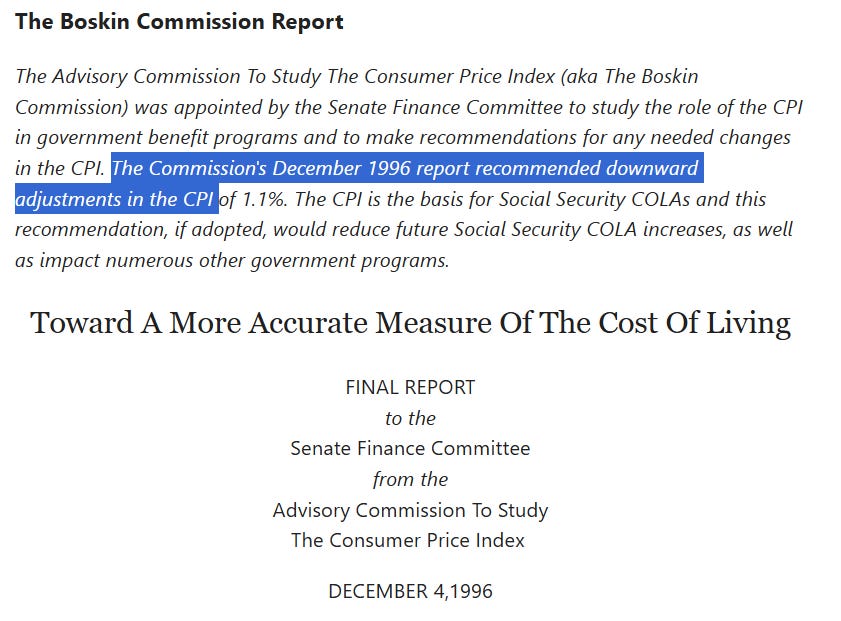
Source: https://www.ssa.gov/history/reports/boskinrpt.html
But hey, maybe I’m wrong and the changes made to the CPI calculation over the years were done with pure intentions – that it was to transfer wealth to younger and future generations. How’s that working out?

Source: https://sherwood.news/personal-finance/first-time-homebuyers-oldest-in-recorded-history/
The median age of a first-time homebuyer in 1980 was under 30 years old. Now it’s 38 years old. That’s a big difference in terms of starting a family.
I won’t even go into Owner’s Equivalent Rent and how that downplays or delays significantly the impact of housing market price increases.
Average Americans are worse off than they were forty years ago. We can talk about home ownership, levels of credit card debt and rates of delinquency, health and obesity rates, drug addiction, life expectancy in certain populations, and all manner of social issues.
It is my contention that the Boskin Commission report played a major role in making all this possible with minimal political consequences, over the past close-to thirty years.
And for those who are actually somewhat well off and are saving and investing for retirement, if you take the BLS’s CPI numbers at face value, you are likely to miss opportunities in the market.
An example:
Look at car prices in the CPI’s new vehicles numbers. In this case, the BLS sets the year 1982 as 100.
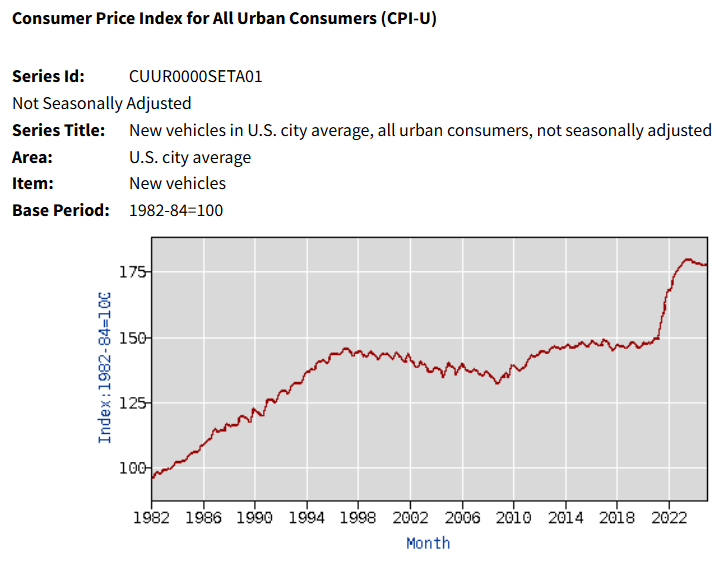
Source: https://data.bls.gov/timeseries/CUUR0000SETA01
Notice that new vehicle prices basically went down for a decade and were flat from about 1996 until right about 2020 when...something happened.
Oh right. They printed a shit ton of money and prices of everything went up. But I digress…
I’m guessing substitutions and hedonic adjustments have been rampant in the data analysis here. But again, for what most people are expecting “inflation” numbers to convey, this didn’t stop car prices from going up year to year.
We know that prices go up. We have known this for decades.
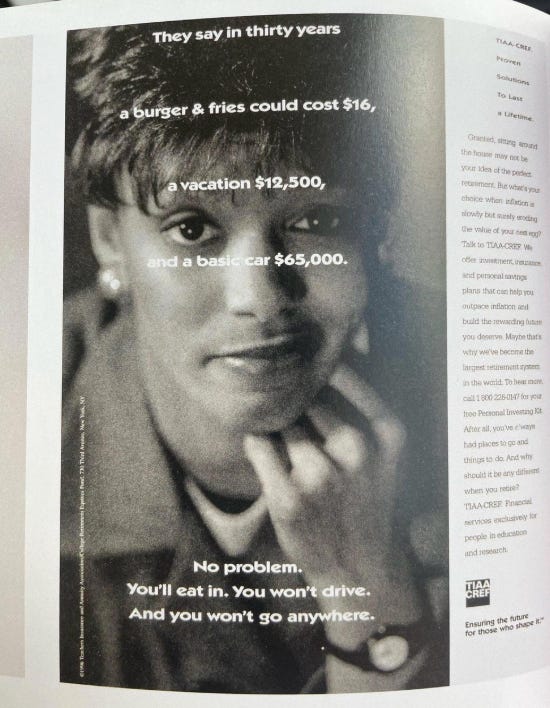
TIAA-CREF a “private provider of financial retirement services in the academic, research, medical, cultural and governmental fields” put this ad out in 1996. How prescient.
Source: https://www.entrepreneur.com/growing-a-business/this-30-year-old-ad-predicted-life-today-and-keeps-going/483350
So when we see misleading garbage numbers for car prices that look like this:
And the person giving you stock recommendations bases their earnings expectations and their assumptions about expected revenue from the sales of cars (whose prices are maybe flat year to year, instead of reality where car transaction prices have basically done nothing but go up and to the right), you’re going to see distortions in stock prices when companies selling cars surprise Wall Street to the upside on revenue and earnings.
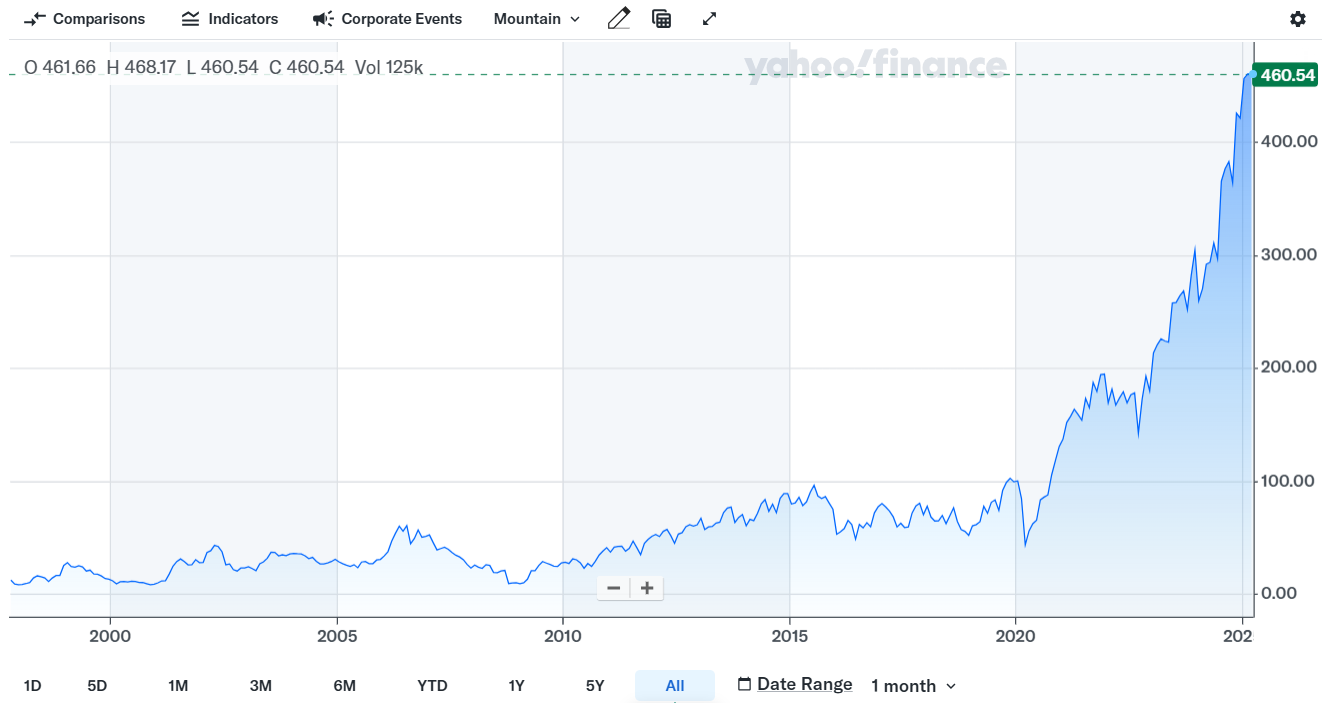
And since a company like Group 1 Automotive’s ($GPI) annual revenue (in nominal terms of course) basically does the “up and to the right” thing, a stock chart like this...
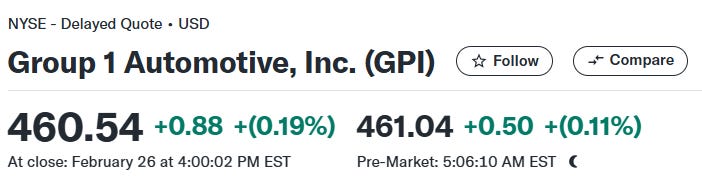
Source: Yahoo! Finance
...starts to make a whole lot more sense.
When “consensus view” is based on faulty inflation expectations, the resulting expected nominal numbers that companies earn gets underestimated and you can find long-term opportunities as stock prices eventually adjust higher.
But average people who don’t own stocks or other assets that governments can’t print suffer because in pretty short order they can’t make ends meet.
And now we are seeing the political consequences. Because a large part of the world’s population has become increasingly outspoken about how we don’t have money to keep fighting wars.
President Trump seems to be trying to stop a war right now, but even that is fraught with accusations of “appeasement.”
Maybe that’s true. Or maybe Trump is just trying to stop everyone from finding out what Mutually Assured Destruction actually entails. I don’t know.
I really don’t know what the right thing to do is. That’s (one of the many reasons) why I could not be President.
But hey, at least weapons sales count towards GDP numbers, right? People with influence actually think that way.

Jake Tapper looking on the bright side.
Source: https://edition.cnn.com/2025/02/24/world/video/the-lead-donald-trump-putin-zelensky-ukraine-russia-jake-tapper
Tapper: As you know, most of the money that went to Ukraine was military aid, weapons, that were manufactured and purchased in the United States.
Burchett: So you’re paying off the war pimps at the Pentagon to prolong the war. Men are dying because of somebody’s profit sheet, is what you’re saying. And that’s what this country is about. And that is wrong and that needs to stop and it’s stopping under Trump. And that’s why both sides are quietly pitching a fit right now, because they’re not going to get rich off young men dying and old men making terrible decisions, and that’s exactly what’s going on.
Trump has been very clear that he wants this war to end. Americans voted him into office knowing full well that this was part of his platform.
Some people don’t seem to want the war to end. And maybe that’s completely for noble reasons for most – not wanting to appease belligerent, land-grabbing leaders, for instance. But some of those people are undoubtedly the “war pimps” Representative Burchett is talking about above.
Anyone paying attention to the European defense companies that I have mentioned in a previous post will know what I’m talking about.
Stock charts of Leonardo (LDO IM), Rheinmetall (RHM GY), Thales (HO FP), to name a few, have the trajectory of a surface-to-air missile.

Michael Shellenberger: Another life-long liberal turned “far right” lunatic.
Source: https://substack.com/@shellenberger/note/c-95915248
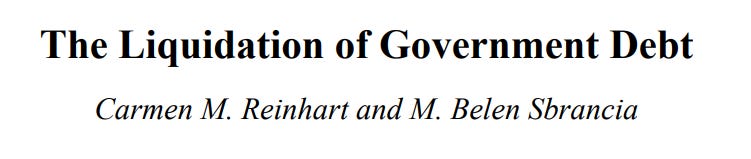
And all this unsavory talk of war brings me to another boring AF academic paper.

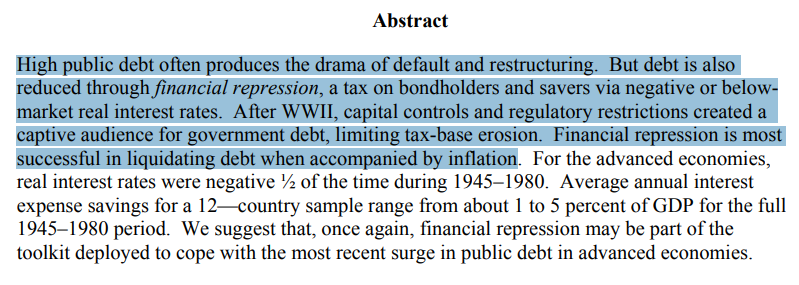
Source: https://www.imf.org/external/pubs/ft/wp/2015/wp1507.pdf
If you want to understand the world economy and what is going on in the world right now, I think this is one of the most important academic papers of the past two or three decades for you to read. The authors go through all the tools governments use to implement financial repression on their people. Boskin’s CPI tricks are only a part of it.
In this paper, they say the quiet part out loud. Financial repression is “a tax on bondholders and savers via negative or below market real interest rates.”
And financial repression is “most successful in liquidating debt when accompanied by inflation.”
The words “War” or “WWII” or “WWI” are mentioned over ninety times in this paper.
But something that seems to escape the authors is a simple fact.
War is hell.

“Hell” went on for another ten years after this photo was taken. Nixon had to make sure that Communism didn’t spread, right? All it cost was a soft default on US debt by going off the gold standard once and for all.
Source: https://rarehistoricalphotos.com/soldier-war-is-hell-vietnam-1965/
I read in that referenced article that the “War is Hell” quote originates from William Tecumseh Sherman’s address to the graduating class of the Michigan Military Academy in 1879. Sherman was a Union Army general during the American Civil War.
He succeeded General Ulysses S. Grant as commander of the Western Theater of that war in the spring of 1864. He reportedly said:
“I’ve been where you are now and I know just how you feel. It’s entirely natural that there should beat in the breast of every one of you a hope and a desire that someday you can use the skill you have acquired here. Suppress it!”
The General continues.
“You don’t know the horrible aspects of war. I’ve been through two wars and I know. I’ve seen cities and homes in ashes. I’ve seen thousands of men lying on the ground, their dead faces looking up at the skies. I tell you, War is Hell!”

William Tecumseh Sherman photographed in Washington D.C. in May 1865
Source: https://en.wikipedia.org/wiki/William_Tecumseh_Sherman
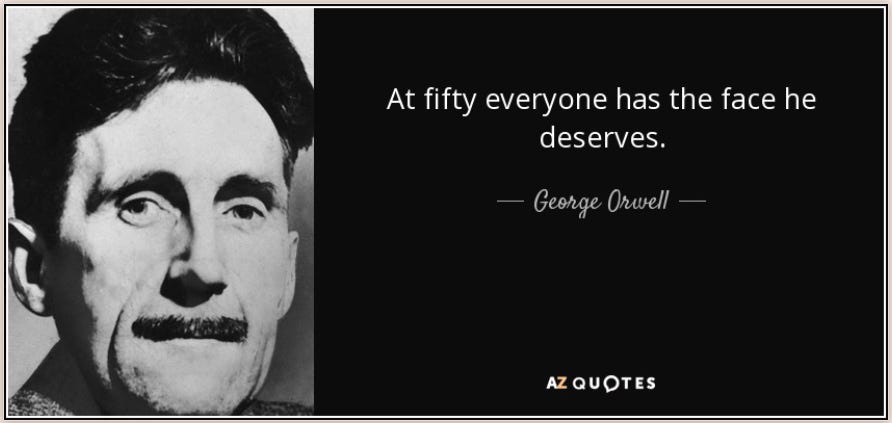
General Sherman was 45 years old when this photo was taken. His weathered and withered face reminds me of another quote.
Source: https://www.azquotes.com/quote/221243
Turns out, George Orwell knew a thing or two about war.
“War is peace. Freedom is slavery. Ignorance is strength.”
“War against a foreign country only happens when the moneyed classes think they are going to profit from it.”
“The war is not meant to be won, it is meant to be continuous.”
Source: https://www.azquotes.com/author/11147-George_Orwell/tag/war
On that last one, people online normally stop reading there. But this is why you should read actual books. Like, whole books. The following passage brings Orwell’s brilliance and true insight into full view.

Source: https://indivisibleventura.org/an-endless-bloody-road-yes-on-h-r-1274/
But hey, maybe I’m wrong. Maybe war is good for the economy and CPI is a good measure of the true cost of living over time.
Or, it’s all bullshit and investing in companies that benefit from printed money, the massive understating of inflation made possible by the Boskin Commission report, and the revenue and earnings surprises that result from it all is a good long-term way to get yourself into the “monied class.”
Stocks like the car dealer Group 1 Automotive ($GPI), grocery store chain Kroger ($KR), and Starbucks ($SBUX), with a new boss who actually answers his phone after 6pm, are all non-tech related stocks that have all been and should continue to be prime beneficiaries of this paradigm.
With a strong stomach for volatility and a lot of patience they will almost surely benefit significantly from the next Big Print.
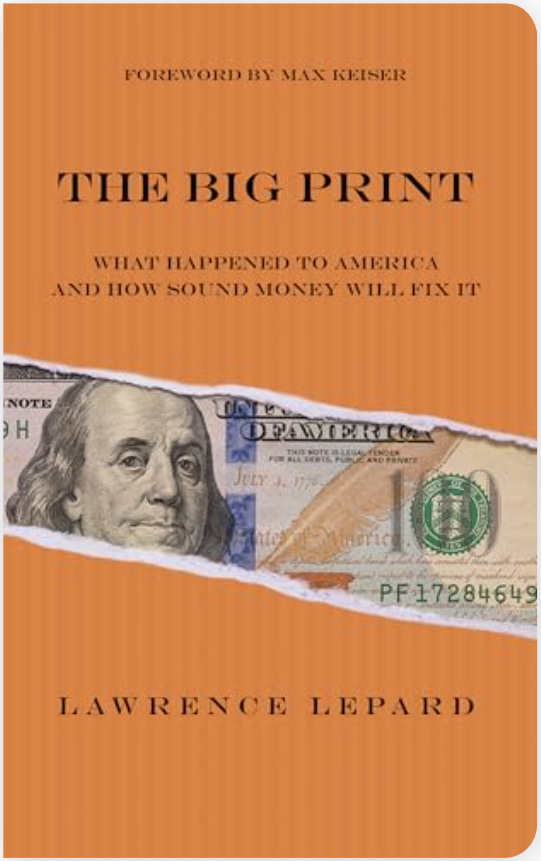
There’s a reason bitcoin and gold have done what they’ve done over the past few years but more on that in future posts.
Source: https://www.goodreads.com/book/show/227804284-the-big-print
The money is broken. The Boskin Commission made it easier for it to stay that way. But it won’t stay this way forever. Make all the money you can from this corrupted system. But do it ethically, be good to your neighbor, and spread the word.
If you understand how this all happened, you can use this broken system to maybe get yourself into the “monied class.”
And then you’ll be able to pay your children’s way out of actually having to fight in World War Four.
Read more articles under our Think Tank Subscription: https://discord.gg/p6rdzmuNQu