
Words Matter
And spelling and punctuation are impotent.

There are no stupid questions – only stupid people who ask questions. – Chris Berman
Every once in a while, a concept, an idea, a point of view just sticks in your head. Long-term memory is a funny thing. I can remember clearly, fleeting moments as a three-year old that are of no import to my or anyone else’s life. A picnic, holding a wiffle ball bat near my parents and next to my godfather, for instance. Album covers that my father owned, etc.

Yet, other than the broad overview, most birthdays, graduations, and weddings – days of great importance to me and my loved ones – don’t necessarily register.
And so it was a moment in my formative years that I heard something that stuck with me. It was the first time I understood the meaning of the word “euphemism.”
Performed by George Carlin, about whom I have written before here, to me, it’s one of his most profound monologues.
I don’t like words that hide the truth. I don’t like words that conceal reality. I don’t like euphemisms, or euphemistic language. And American English is loaded with euphemisms. ‘Cause Americans have a lot of trouble dealing with reality. Americans have trouble facing the truth, so they invent the kind of soft language to protect themselves from it. And it gets worse with every generation. For some reason, it just keeps getting worse. I’ll give you an example of that. There’s a condition in combat. Most people know about it. It’s when a fighting person’s nervous system has been stressed to its absolute peak and maximum – can’t take any more input. The nervous system has either [*click*] snapped or is about to snap. In the first World War that condition was called SHELL SHOCK.
Simple, honest, direct language. Two syllables. SHELL SHOCK. Almost sounds like the guns themselves. That was seventy years ago. Then a whole generation went by and the second World War came along and the very same combat condition was called battle fatigue. Four syllables now. Takes a little longer to say. Doesn’t seem to hurt as much. Fatigue is a nicer word than shock.
SHELL SHOCK! Battle fatigue.
Then we had the war in Korea, 1950. Madison Avenue was riding high by that time, and the very same combat condition was called Operational Exhaustion. Hey, we’re up to eight syllables now! And the humanity has been squeezed completely out of the phrase. It’s totally sterile now. Operational Exhaustion. Sounds like something that might happen to your car. Then of course, came the war in Vietnam, which has only been over for about sixteen or seventeen years, and thanks to the lies and deceits surrounding that war, I guess it’s no surprise that the very same condition was called Post-Traumatic Stress Disorder. Still eight syllables, but we’ve added a hyphen! And the pain is completely buried under jargon. Post-Traumatic Stress Disorder. I’ll bet you if we’d have still been calling it Shell Shock, some of those Vietnam veterans might have gotten the attention they needed at the time. I’ll betcha.
It has stayed with me all these years. I remember the first time I heard it playing late at night in my room before going to bed. It was a school night. One line particularly stuck with me.
“And the pain is completely buried under jargon.”
We are more than a generation removed from Carlin’s Euphemisms monologue. World War I ended over 100 years ago now, and America threw in the towel in Vietnam 50 years ago. And just as Carlin described, this phenomenon has gotten progressively worse. Because those who attempt to eschew blame or manipulate others know well that words matter, and euphemistic language is a great tool for influencing thought.
There are times it borders on ridiculousness. For instance, when Spain and Portugal lost power earlier this year, it wasn’t because of stupid energy policies and substandard electrical grids. Some blamed it on “Induced Atmospheric Oscillations.”
One commenter on Substack was quick to call out this euphemistic, 10-syllable term as something we are already quite familiar with.

I then checked an AI chatbot to see what it thought about this.
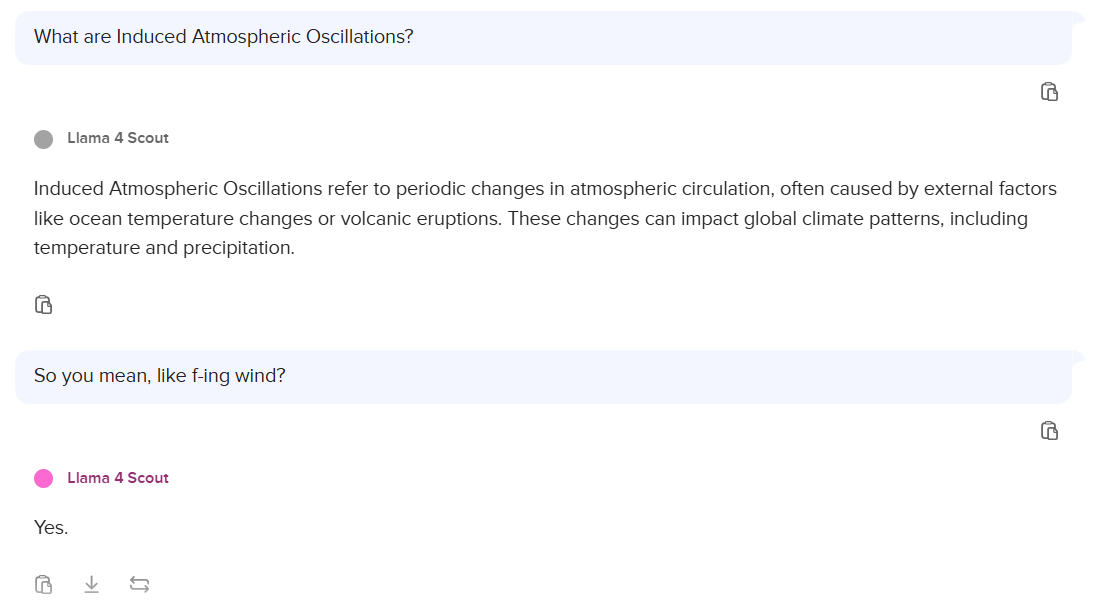
I’m sure it’s more complicated than this. But probably not much. So let’s say the outages were caused by “Wind+”.
Even if terms like this are accurate in certain technical environments,1 a lot of people have caught on to the “lies and deceits” made possible by the use of this type of euphemistic language that George Carlin highlighted all those years ago.
People realize more and more that words matter. We think in language. And when you blur the language you blur the meaning and dull the mind. But it’s easy to call out blowhards who say things like “induced atmospheric oscillations.”
So how is an aspiring language manipulator supposed to proceed?
Well, he goes from: Shell Shock → Battle fatigue → Operational Exhaustion → Post-Traumatic Stress Disorder to…
PTSD
Now the simple concept becomes not only buried in jargon, but the abbreviation into just a few letters makes it easy for liars and deceivers to hide that jargon under a veneer of expertise.
Oh, you mean you don’t automatically understand the abbreviations I’m using? It must be because the very simple concepts that I’m trying make sound complicated in order to put past you just aren’t second nature to you like they are to me.
“BNPL” is a perfect example of this. And there was a great discussion about it between a couple of right wing lunatics the other day.
BNPL stands for “Buy now, pay later.”
Tucker Carlson had never heard of it. If you’re a multi-millionaire I guess it makes sense that you wouldn’t have to finance your groceries. But he was incensed when he learned about it.
“Shut those fuckers down tomorrow,” Carlson said.
It’s yet another example of up being down, black being white, and left being right in this time in history, where socially conservative commentators advocate for shutting down the “fuckers” who take advantage of the poor and the youth with predatory lending practices.
Klarna is the Swedish company they mention. It is preparing to IPO, though that has been delayed for some reason. I wouldn’t touch it with a 10-foot pole when it eventually does.
Affirm ($AFRM) is up only about 34% since it IPO’ed2 in January 2021. An annualized gain of just around 7% in a time that the S&P 500 has returned over 75% and a 13+% annualized gain (with dividends reinvested), is not at all impressive for the risk of owning a stock in the morally shitty, predatory business that is facilitating the theft of Gen Z’s financial future.
Afterpay is the Australian company mentioned and it was acquired by Jack Dorsey’s Block (XYZ) in 2022.
People like me are normally ones to heap praises on guys like Jack Dorsey. His advocacy for uncensorable freedom money with bitcoin, and uncensorable freedom tech social media protocols with his promotion of Nostr, and his recent development of bitchat, a messaging app that operates through Bluetooth mesh networks to function without the internet, are all laudatory.
And Block’s Cash App has done more over the past 6-7 years to simplify on-ramps bringing average Americans into bitcoin than most people realize. Also, their bitkey hardware wallet has made self-custody of bitcoin simple and losing funds almost impossible. There are privacy trade offs with the bitkey, but self-custody is basically terrified-of-tech-Baby-Boomer-proof now.
Despite owning Afterpay, when all is said and done, I think on balance, Jack Dorsey will be seen as a massive force for good in the world. And Block should do very well over the next couple of years I think. The stock is way below its all-time high, and they hold 8,584 bitcoin on their balance sheet as of their last reporting. Still, that Buy-now-pay-later business represents everything that is wrong with the modern American economy. It’s bad. No two ways about it.
So I don’t use euphemisms. And I avoid using abbreviations like BNPL. You could call them Predatory Debt Trap Financing Operations. But I just call them what they are — usurers.
Words matter. And simple, direct, honest definitions matter. Again, we think in language.
If I say, “Japan’s Prime Minister had a very big erection over the weekend,” it conjures up an image that you can’t avoid even though you want to – even when you know exactly where the mistake in the sentence is.
And if someone says, for instance, a sentence like, “Michael Saylor is running a Ponzi scheme with his company’s bitcoin treasury activities,” it may activate some of those unpleasant, PTSD-inducing long-term memories of past financial collapses from the deep recesses of your mind. But if you have anything above a cursory understanding of what Saylor is doing, and are operating on any mental plane higher than just a financially fearful, amydgala-driven lizard brain, you will know exactly why this oft-stated MSTR = Ponzi is a specious comparison.
Does it take a leap of faith to believe that Saylor’s actions will send MSTR shares to new heights?
Yes, to some extent it does. You need confidence that Bitcoin the network will stay decentralized and secure, and that bitcoin the asset will not go to zero against the US dollar. But that does not make it such that Saylor is playing a confidence game with investors.3
Words matter. You will miss many an opportunity if you fall prey to lazy thinking. To avoid that you just need to do a little bit of homework with an open mind. Then, if you’re not convinced, at least you know why, and you will be able to explain why in simple, honest, direct language.
For Saylor’s Strategy (MSTR), you need to believe that the fiat monetary tokens created by central bankers planners will continue their trend toward zero against real assets. Nothing in the past 110 years – and the past five years in particular – has led me to believe any differently.
And if that is the case, then it’s not much of a stretch to think that at some point in the future, with its continued path of institutional adoption, that bitcoin will start to be seen as a highly-credible, verifiable and trusted form of collateral. That doesn’t sound like a Ponzi scheme, as I have heard many people call MSTR.
A Ponzi scheme has a specific definition. It’s a form of fraud that lures investors and pays “profits” to earlier investors with funds from more recent investors.4
A company issuing debt and paying interest (a coupon) on that debt, or giving some other perk, such as being higher in the capital structure but with the right to convert into common shares of the company, is not a Ponzi scheme – especially when the amount of interest to be paid on the debt is basically covered by the operating profits of the original software business. And then to convert the proceeds of the debt issued into an asset that gains in purchasing power over time, again, is not a Ponzi scheme.
If you want to get technical, Social Security is much closer to the spirit of what Charles Ponzi was going for back in the 1920s. Once the flow of new entrants dry up – meaning when the demographic picture is less favorable – there won’t be any more money to pay off the older entrants.
One might contend – and many do – that the whole fiat debt-based system we live in is one big Tower of Babel about to collapse under its own weight. But the central bankers planners controlling the cost of money and inflation-taxing you without your vote of consent won’t let that happen, will they?
Darkside Scott discussed this in a recent TFTC podcast with Marty Bent.
We’re at a point now where we can’t even print our own money, the way the system is designed, without paying a bunch of banksters interest for the pleasure of doing so. And so when the Fed goes out into the open market and buys a bunch of 20-year bonds, essentially monetizing the debt, we’re printing money, but at the same time the Fed now owns those bonds, and we as the citizenry get the pleasure of paying them interest for printing our money. That’s a ridiculous system. Everything about it makes no sense.”
Do you think that just might have a little bit to do with why the Fed seems so reluctant to cut rates? Makes you wonder about the whole incentive structure.
And so from that point of view, what Michael Saylor is doing with Strategy is not a Ponzi scheme at all. If you subscribe to a certain worldview, it makes a whole lot more sense than Americans unwittingly paying a banking cartel hundreds of billions of dollars a year in interest for the privilege of devaluing their own currency and sucking the economic lifeblood out of future American generations.
All it requires is a handful of assumptions. Namely that:
Ok, Elon actually got this one right | X/Twitter Bitcoin will stay decentralized and secure, and will preserve and grow purchasing power over time.
And if the first two assumptions hold, then:
Bitcoin will come to be considered a pristine form of collateral, easily verifiable and with no counterparty risk to those who custody it correctly.
Bitcoin will eventually come to be considered a sort of purchasing-power-protecting “risk-free asset” that replaces U.S. Treasuries for that purpose. The U.S. government will always pay you, the holder of treasuries, every dollar you’re owed (unless you really piss them off like Russia, or Iran, or Venezuela, or [insert next enemy here] have). But in a future world where the most important consideration is that 1 BTC = 1 BTC and you can verify you have control and custody of it, the purchasing power, and organic demand for those treasuries will wither – outside of stablecoin demand.5
With Strategy’s convertible debt, and its preferreds, STRK, STRF, STRD, and now STRC, Saylor is creating a sort of fiat yield curve backed by bitcoin.
Every day now there seems to be a new media report of a “crypto treasury company.” With lazy thinking it’s easy to brush it all off as a fad or a scam – this cycle’s ICOs.6 But there’s a difference between what Michael Saylor is doing with Strategy, what Jack Mallers is attempting with XXI, and what Adam Back will try out with BSTR, and the grifting LARPers7 pretending that centralized manipulate-able tokens like ETH and Dogecoin will provide any benefit to anyone other than the foundations that control these POS networks.8
Saylor’s business – Strategy’s business now – is selling debt. And there is a massive institutional demand for debt at the right return. And Michael Saylor is saying that Strategy – backed many times over by the pristine collateral that is bitcoin – is going to be a more reliable lender than the US government. As the fiat debasement kicks into high-gear, given enough time, I think a lot of fixed income investors will believe he’s right…
And with all the institutional adoption that is coming, and a hard stop on the supply available to play the traditional fiat games of the financial system, I quote Darkside Scott with Marty Bent again.
You can’t have a bit-bond unless you have bitcoin backing it. If you’re going to do a 10-year bit-bond you’re gonna have to take bitcoin and sequester it for ten years, right? Well, that bitcoin’s not going to be available for loan, right? You can see all of where we’re headed with the financialization of bitcoin, is that it’s going to create a lower supply for the derivatives market...What does this do to the derivatives market as all of this bitcoin gets sequestered?
And then what about all the Lightning Network channels and Cashu mints9 that are opening up to allow people to transact anonymously peer-to-peer? That’s a growing supply of bitcoin that will never be available for OTC10 trading desks to lend out or to source in order to deliver on their obligation to another counterparty.
The financial system is going to look very different in 5-10 years than it does today. At that point we might not even have a Federal Reserve as we think of it today. So if you hear a banker, a media commentator, or a politician bloviating about how they think bitcoin is a bubble, or that Michael Saylor is running a Ponzi scheme, just remember that they do not understand what they are talking about. To be sure, there are tons of scams out there. Words matter. And to the discerning eye and ear, it’s fairly easy to separate the signals from the noise – the scammers from the reputable. Want a good rule of thumb? If you see the word “crypto” anywhere it’s likely a scammer, a grifter, or at best, an honest degen gambler.11 We haven’t even seen the beginning of the real degeneracy in this cycle. And it’s going to be sponsored by the biggest banks on Wall Street this time. Buckle up! And stay alert.
Because words matter, and prosperity can be attained by those who take the time to dig into their meaning, translate it all in their heads into simple, honest, direct language, and make those light bulb moments a part of their long-term memory for the rest of their days.
❤️ “Like” this post and we’ll remember your kindness forever.

As an example, if you’re a baseball fan, you know when someone asks you, “How many At-Bats did Shohei Ohtani get tonight?” they’re not technically talking about At-Bats (ABs). They are talking about Plate Appearances (PAs). ABs don’t include times a batter appears at the plate that result in a walk (BB - stands for Base on Balls), a Hit By Pitch (HBP), a sacrifice fly, a sacrifice bunt, or reaching base due to catcher’s interference. But if you try to clarify the meaning of the person’s question before answering they will (justifiably) punch you in the face for being a pedantic dickhead. In a non-technical setting, “Induced Atmospheric Oscillations” are Plate Appearances, while everyone knows that we’re just talking about the fucking wind (ABs).
Yes, I realize I just abbreviated “Initial Public Offering” twice. That abbreviation isn’t just second nature to you like it is to me? What are you stupid or something?

Stablecoin development right now is incredibly fascinating, and I will delve into it in a future writing. But at the end of the day they are just digital tokens that are programmed to be debased over time. You could also accurately call them “digital guaranteed loss of purchasing power tokens.”
ICO stands for Initial Coin Offering – a previously common practice of pre-mined shitcoinery where founders and their friends/benefactors hyped up vaporware garbage tokens and then found exit liquidity by dumping them on retarded retail speculators.
LARP = Live Action Role Play
POS = Proof of Stake = Piece of Shit. It’s ironic that no one really seemed to think of this before the world settled on this abbreviation.
I won’t delve into the Lightning Network or Cashu mints here as it would turn into a 3-hour read, but needless to say, this stuff is growing fast, and if you haven’t used either, then you have barely scratched the surface on what the potential for bitcoin is as a peer-to-peer payment system with true digital anonymity. The real inner workings are too technical even for me, but you eventually get a feel for it. If you really get into it, enjoy going down the rabbit hole!
OTC = Over the Counter. Basically off-exchange trading of assets or synthetic representations of assets.
It’s not 100% of course, and I think a good exception is if you see OG bitcoiners who started podcasts or blogs in like 2013 when the word “crypto” didn’t have the shitcoin stink attached to it that it does now. And of course, if you want to speculate on any stock, token, or whatever, you should have the right to do so. I wish you nothing but happiness, luck, and prosperity.
Usurers is still to complicated a word,
Fuckers is simple and precise enough. less syllables too