
Silver Meddle
AI slop, profit-taking drops, and year end monetary metal volatility.

“I carry the sun in a golden cup, the moon in a silver bag.” – W.B. Yeats
Elementary penguin singing Hare Krishna. Man, you should have seen them kicking Edgar Allan Poe. I am the Egg man. They are the Egg men…
Oh wait...No, forget all that. I am definitely not the Walrus.
For those of you who don’t understand what just happened, the “Walrus” was, of course, John Lennon – or maybe Paul McCartney if the White Album song “Glass Onion” is to be believed.
We start off this first piece of 2026 with complete gibberish. It goes to show that even gibberish – originating from an actual human mind and when wrapped in the context of the human experience (even the experience of being completely out of one’s gourd on LSD, for instance) – can move us. “I Am the Walrus” was, and still is a fabulous song. It was way ahead of its time in 1967.
But 2025 seems to have been the year that gibberish and AI hallucinations became ubiquitous – and where uninspired AI slop content reached a sort of critical mass tipping point. Maybe we are a bit paranoid about looking gullible, and about falling for and forwarding cheap fakes or other garbage on to others, but this seems to be the majority of the content that we encounter on social media these days.1
“I Am the Walrus” and other nonsensical songs or works of art entertain us in ways that AI generated content likely never will. Call us old fashioned, but AI generated “art” gets boring really quickly. This is probably why NFTs died the unceremonious death that they did. AI-generated art is cute for a bit, but then it usually gets seen for what it is – pointless.
And it’s not even really new. We’ve had human-replicating art technology for over 100 years in that sense.
But the novelty of that wore off in like 1924. No one today would go to a concert to watch a player piano “perform.” Maybe it boils down to the uncanny valley effect, where something that looks almost human really tends to disturb something deep down inside of us,2 but despite recent reports of popularity, it will probably be a long time before the masses go for fully AI-generated, actor-free, “live action” movies.3

And so it is with this in mind that we think, write, and post our views on Substack, Discord, and Nostr.4 You will see no AI-generated content from us.
That cannot be said for a whole lot of the precious metals commentary that has inundated YouTube and social media platforms over the past week or so. Silver in particular has seen that blow-off-top-type surge, and our Substack “For You” feed has been completely flooded with pieces on what various obvious chatbots “think” is going on.
For instance, late Sunday into Monday morning on December 29th rumors started circulating online that a “systemically important” bank failed to meet a margin call on short silver positions. The position was supposedly force liquidated, and the bank required a bailout to avoid collapse. It seems this was one of the first tweets to start circulating this “news” on X/Twitter.
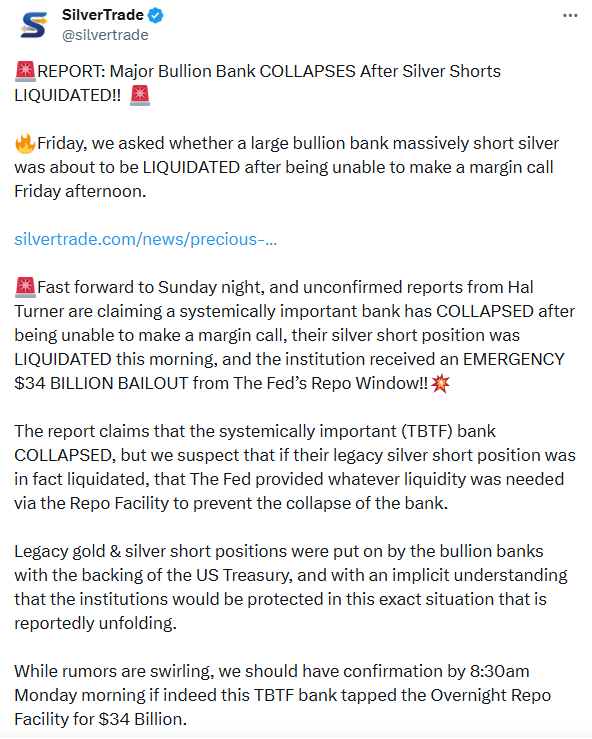
Digging deeper, the content of this tweet apparently originated from a radio host named Hal Turner. He had posted this (no highlights added and all in the original post):
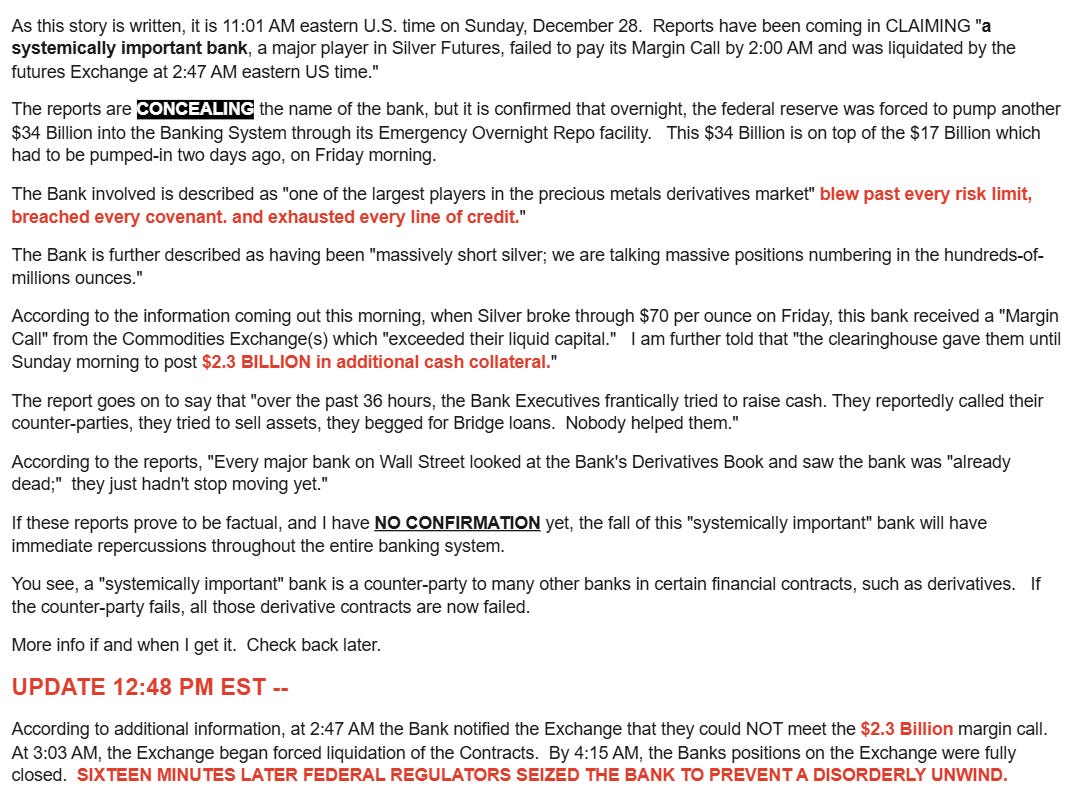
In the post he says specifically that he has “NO CONFIRMATION” – in all caps, bold, and underlined – of anything he is saying.
Red flags abound…
Hal Turner has a reputation for dealing in conspiratorial stories.
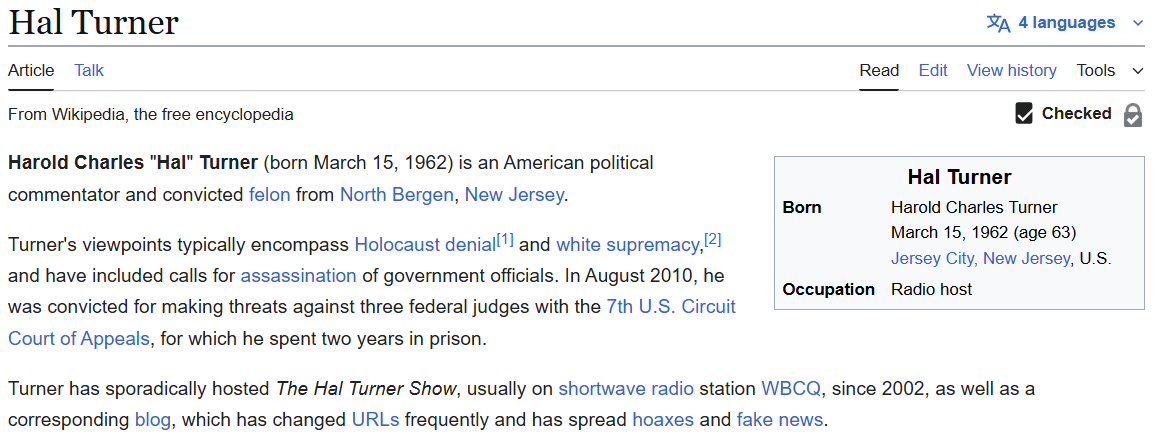
Now, to be fair, if we’ve learned anything over the past five to six years, it’s that just because Wikipedia implies that someone is a conspiracy theorist, or that he/she spreads “fake news” doesn’t mean that the claims or reports by those people are actually false.
That being said, we do not think Turner is offering enough evidence to make us believe that these claims are true. Let’s be overly generous and forget about proof. Just evidence would be enough to get us to at least take the claim seriously. Yet, still. Nada. Niente. Zip. Zilch. Nothing.
But extraordinary claims require little-to-no evidence these days to go viral, and additional fuel was thrown on the internet fire when the Fed data on repo facility usage was released that Monday morning. Usage hit almost $26 billion, and some internet commentators interpreted this as some sort of emergency bailout for whatever secret bank Hal Turner was talking about.
To put this into perspective though, here’s what that $26 billion ($25.95 billion to be exact) looks like:
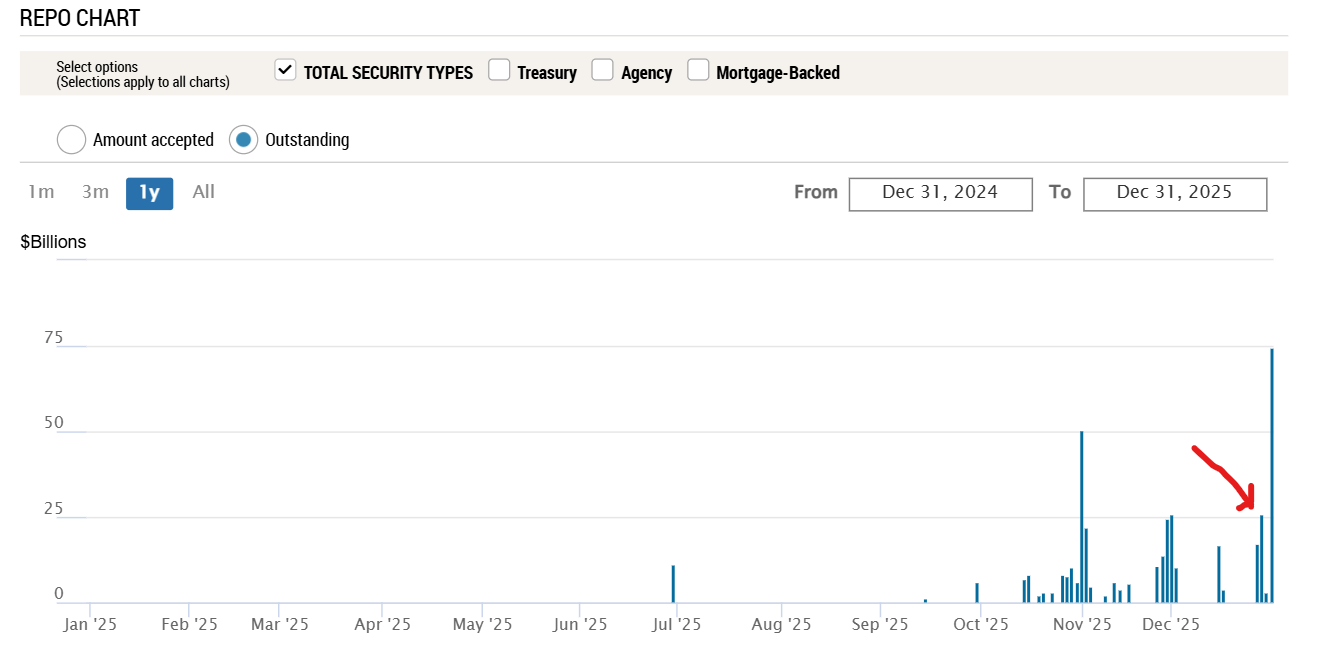
This is not particularly out of the ordinary over the past few months for the banking system’s month-end liquidity needs.
That later spike on December 31st to almost $75 billion might be a sign of something rumbling in the plumbing of the financial system, but that’s not what commentators were talking about on December 29th. They were clickbaiting.
Now, maybe it’s not a good thing that this standing repo facility is being tapped more often in recent months, but nothing here points to a red flag that something is seriously wrong now and that a “systemically important” bank just blew up.
Silver’s recent volatility, where it surged to $84 per oz. on Friday December 26th, crashed to $71 per oz. on Monday the 29th, regained a lot of lost ground to $78 on Tuesday the 30th, and then fell again to $70 and change on the last day of 2025, is to be expected during a relatively illiquid time of year on an asset that has had a massive run up, where many traders are probably trying to lock in nice gains before year end on something that is about to become a “strategic metal” that China will subject to export curbs starting January 1, 2026.
More volatility is to be expected and the story was commented on in our Discord server by the always astute FxTyrant. This was posted shortly after the Asian trading hours silver top as it crashed down to around $72 per oz.
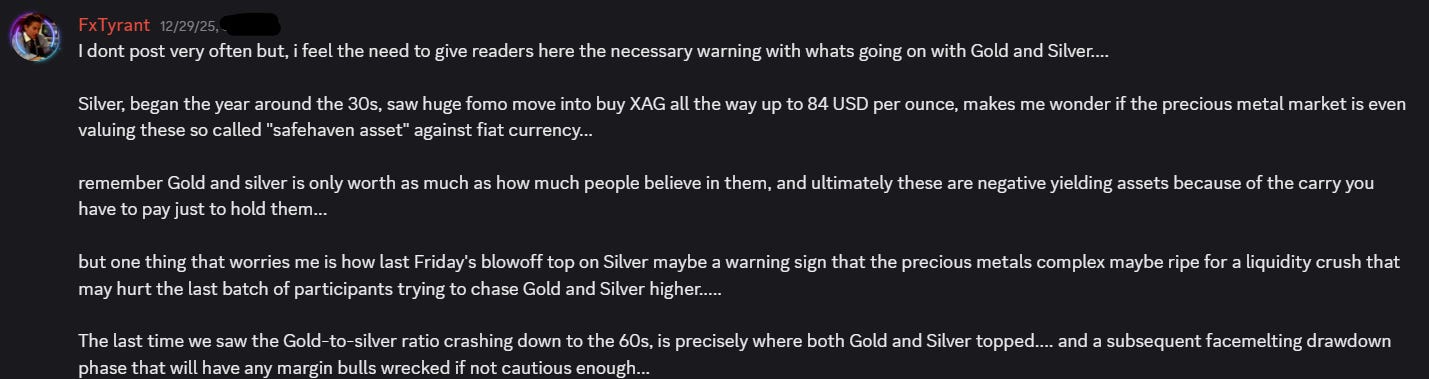
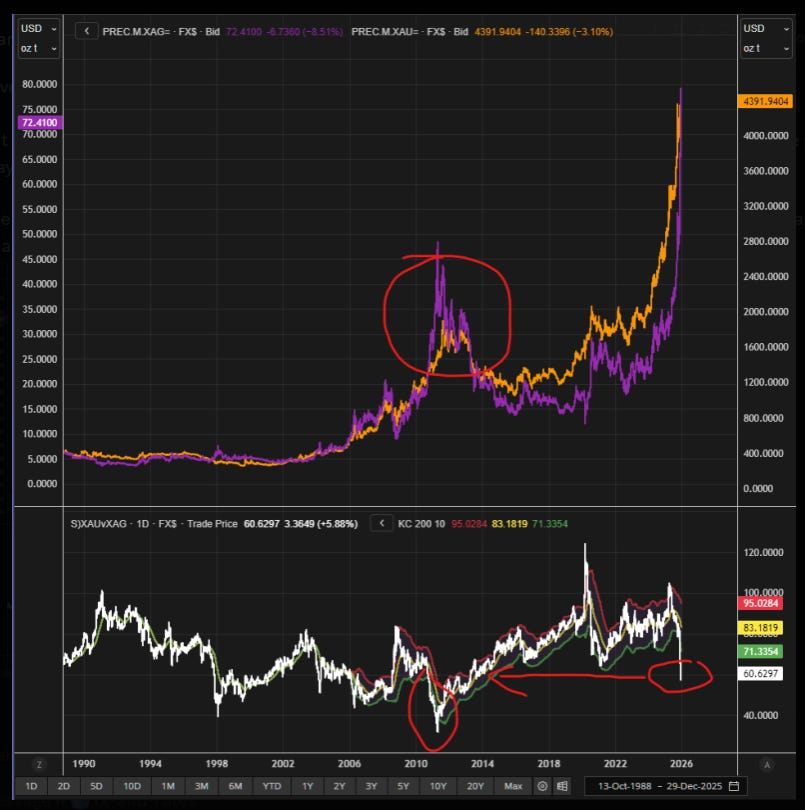
In the short-to-medium term, we think FxTyrant is likely correct. Under normal monetary conditions the “negative yielding asset” aspect of holding physical gold and silver would be a legitimate concern. Longer term, these are not normal monetary conditions, however.
One meme going around a lot recently is important to remember for the gold and silver stackers (as opposed to traders – even mid-to-long-term trend following traders) who are watching the gold/silver ratio (GSR) collapse recently. As FxTyrant warns, we haven’t seen a GSR at 60 in over a decade. But do remember to zoom out:
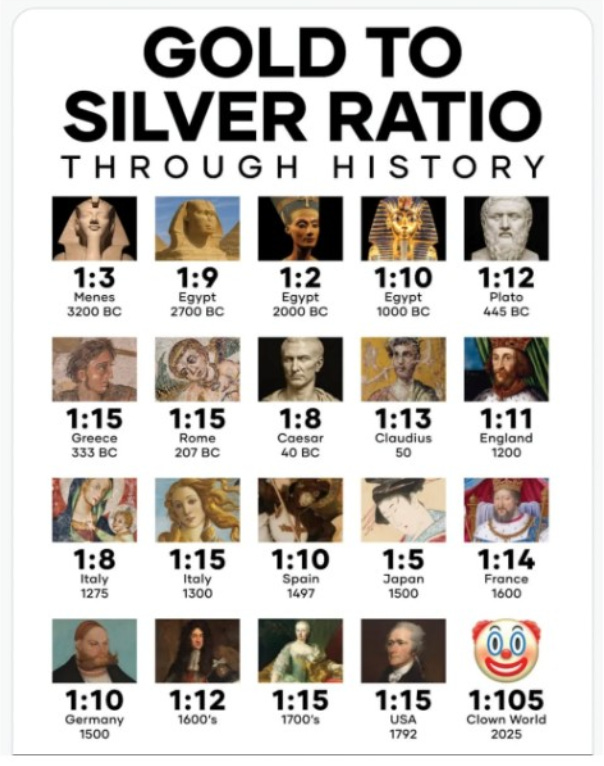
But don’t get too excited. A return to 1:15 might have to be measured in centuries. A gold/silver ratio at 30 over the next five years wouldn’t surprise us, however. We think this is around where things stabilize under whatever new monetary regime is coming. With the next Big Print, if gold is “revalued” at some point to the $8,000 to $10,000 level, that would put silver in the $267 to $333 per oz. range.
Sounds crazy? It isn’t, as we’ve seen it before in real terms. More on that shortly.
But we agree with FxTyrant on what is currently happening, and see consolidation on silver and gold in US dollar terms as likely, with maybe a few months of sideways trading and downside pressure as Comex margin requirements likely keep getting raised.
Remember, a couple of concepts from the forever-talking-his-book-but-not-wrong Egon von Greyerz here:
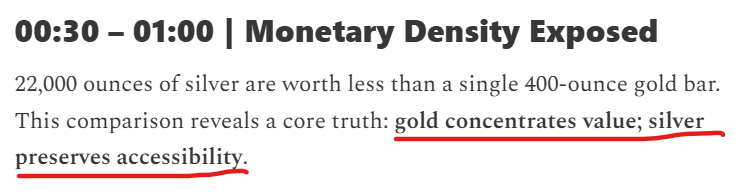
And here:
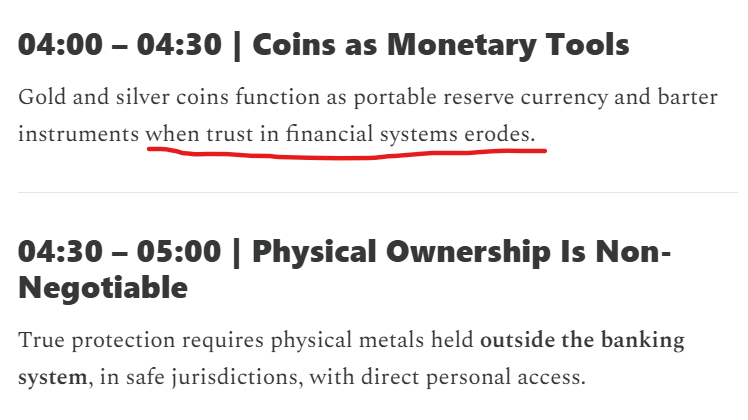
In a monetary reset, trust in financial systems will erode. It already has to a great extent. And while most would not have trouble understanding that gold concentrates value, the importance of silver preserving accessibility is often overlooked. If you understand how important that concept actually is, silver’s rally and potential for continued long-term gains against fiat currencies makes all the sense in the world.
And always remember, the previous two silver surges of the past fifty years – the Hunt Brothers’ silver squeeze of the late 1970s, and the QE-fueled post-financial crisis surge to ~$50 per oz. in 2011 – hint that there is still plenty of upside in 2026-and-beyond in dollar terms.
If we use official (i.e. bullshit) Consumer Price Index (CPI) numbers to adjust $50 in 2011, that would equate to ~$72 – right around where silver is to start 2026. And $50 back in 1980 would correspond to $196.68 in 2026 dollars. So don’t think for a second that $200 silver is crazy. And that doesn’t even account for the actual inflation and debasement of the currency that has ravaged the economy over the past four and a half decades. Again, that’s using bullshit official CPI numbers. If we accounted for inflation properly, $50 in 1980 just might correspond to, oh, about $267 to $333 maybe? Weird, huh?5
These previous two surges in silver prices coincided with significant declines in real yields. And they ended when monetary policy and decision makers conspired to raise either margin requirements or interest rates in order to wipe leverage out of the system.
Regarding the Hunt brothers, Vince Lanci recounts the end of the surge here (emphasis added):
“In January 1980, the CME enacted Silver Rule 7, which imposed stringent restrictions on the purchase of silver futures on margin. This rule significantly increased the amount of collateral required of traders, thereby curbing leveraged speculative buying. It also included restrictions on the number of contracts one could hold and effectively halted new margin buying...
In addition to the CFTC and CME efforts, the Federal Reserve also played a role in breaking the Hunt brothers. Fed Chairman Paul Volcker sharply raised interest rates in January 1980, from 11.75% to 20.0%, making margin borrowing for the Hunts and other speculators much more expensive. One week after the Hunts ceased market activity, Volcker began lowering interest rates.”
And on the 2011 surge:
“The boom ended in 2011 when the Chicago Mercantile Exchange (CME) raised margin requirements five separate times in nine days. The graph below, courtesy of Business Insider, shows the doubling of silver margin requirements and the destructive impact on prices. The CME’s action forced deleveraging in the futures markets, resulting in silver falling by nearly 30% over a few weeks.”
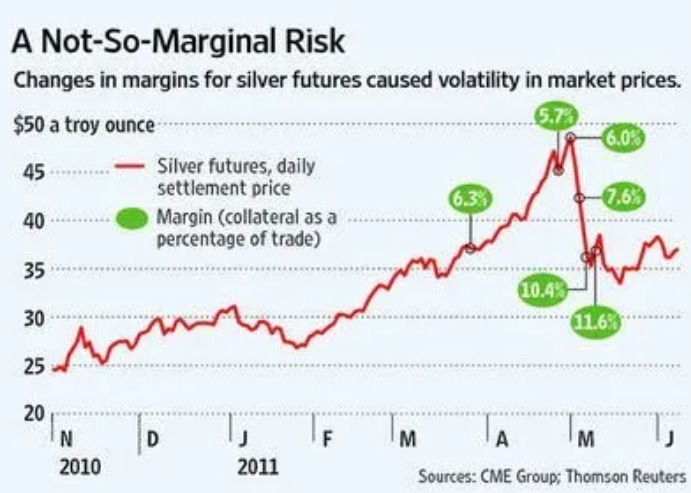
And this is what we are seeing again at the CME.6
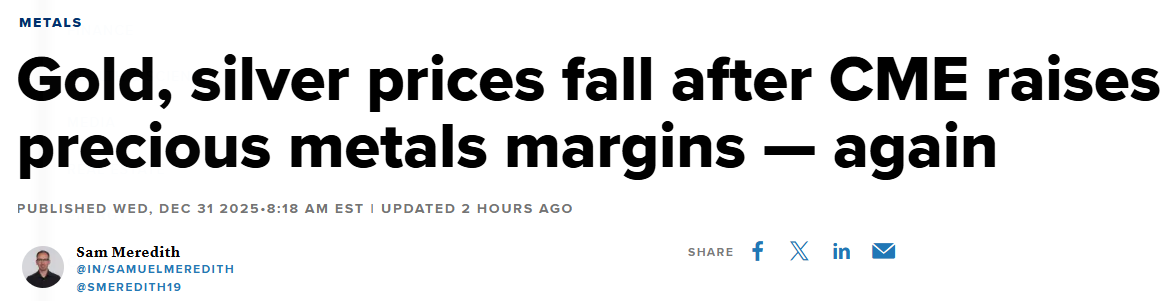
Again, this doesn’t mean that gold and silver won’t continue their secular bull market surge higher versus the dollar over 2026 and beyond. But the leverage is getting flushed out of the system as we speak and there’s still more to go. Once the gamblers and poor risk managers are swept away the monetary and fiscal conditions of the United States under the Trump administration will remain as accommodative and as poor, respectively, as they have ever been. In that environment, regardless of any meddling in the gold and silver markets, the monetary metals will continue to shine.
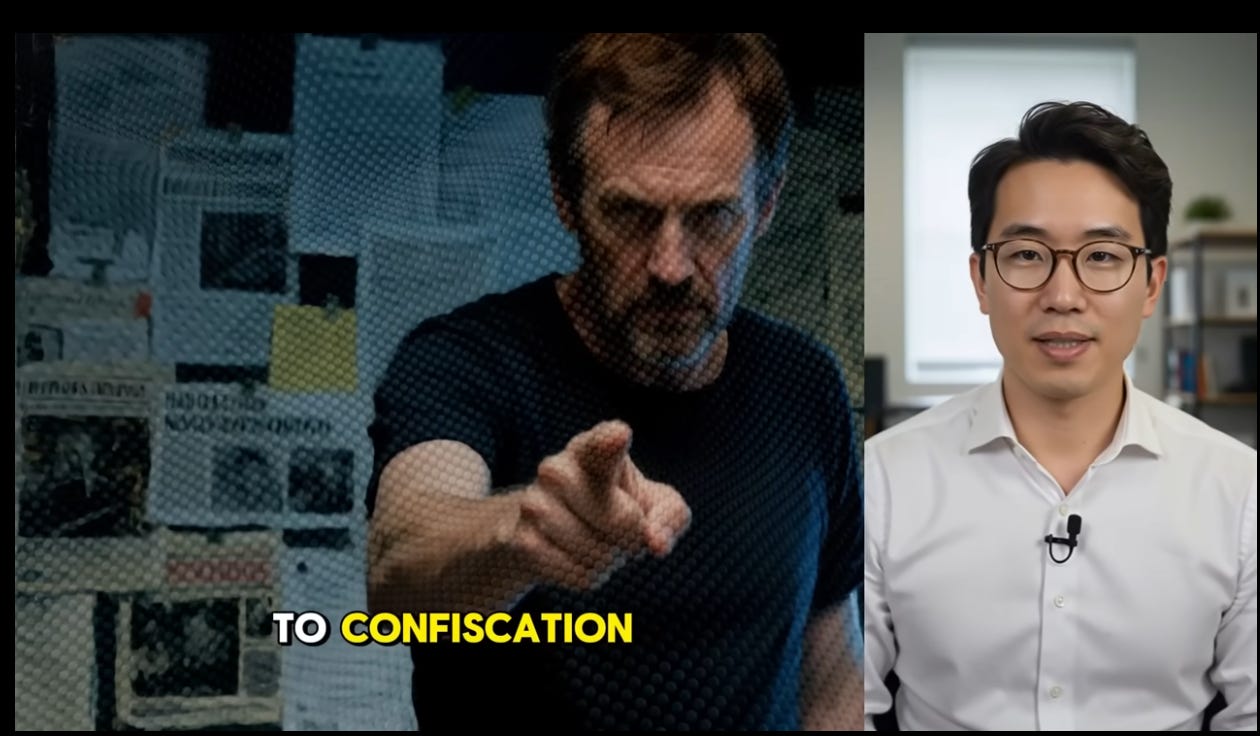
Just don’t get sucked in by every screaming thumbnail, every “AI Asian guy” YouTube video, or the social media posts with the [This isn’t X (em dash) it’s Y] sentence structure.7 Your time is too valuable to consume slop like that.
❤️ “Like,” subscribe, and share this post to support honest to God human resistance to AI slop in 2026.
We of course use AI chatbots for basic things, sometimes as a substitute for Google searches. And as a writer, if you are looking for a “synonym” for a multi-word concept they can be very helpful. But that’s about it as far as these posts go.
Cartoons and other types of animation are a different story because we know they are fake. It’s the trying to pass off the fake as real that still seems to be irksome to humans at this point in history.
Discord: https://discord.com/channels/770603135776718859/903314517595922483
Nostr: npub18x4s8309wv7qlpjv6cl4eswgsylaklpf6gc9ws6erg5zcg2se7zstd447z
Nostr clients (i.e. apps) that you can download on your phone include Primal.net, Damus (on iPhone), Iris.to, or Yakihonne, to name a few.
Feel free to ⚡ ⚡ zap ⚡⚡ us some satoshis on Nostr to support our work :)

Lightning wallet: d70d8f@wallet.yakihonne.com
You can read about it here:
The This isn’t (something) followed by an em dash (i.e. a really long hyphen — ) and then This is (something else) is a sentence structure that seemed to start popping up everywhere in things we were reading. Repeated patterns tend to annoy us so we even Googled why this seemed to be the case. It turns out, it’s a very common writing structure of AI-generated content. So if you come across it, know that it is a strong indicator that what you’re reading was written by a chatbot. The problem with this, however, is that the things that get clicks lead the way to other actual people emulating similar styles. So there seems to be a lot of real people using this AI slop sentence structure now too. We will not do this—unless it gets us lots of clicks and Likes! But rest assured, this is not selling out — it’s raising visibility!